
How to Paraphrase in IELTS to Boost Your Band Score?
Many IELTS candidates underestimate the power of paraphrase in IELTS, treating it as just a simple synonym-swapping exercise. In reality, the ability to paraphrase effectively is one of the most important skills you can develop for the exam. It directly impacts your scores in Writing, Speaking, Reading, and Listening.
In this comprehensive guide, we will explore what paraphrase in IELTS truly means, why examiners value it so highly, and how you can master this essential skill across all four sections of the test.
See also: Collocations for IELTS: The Secret to Boosting Your Lexical Resource Score
What Is Paraphrase in IELTS?
Paraphrasing is the skill of rewriting a sentence or passage using different words and grammatical structures while preserving the original meaning. In the context of IELTS, this means taking the information from the question prompt, a reading passage, or a listening transcript and expressing it in your own words.
Paraphrase in IELTS is not simply about finding synonyms for every word. It involves understanding the core meaning of a text and then reconstructing it using a range of vocabulary and sentence structures. This demonstrates to the examiner that you have a sophisticated vocabulary and sufficient grammatical range.
Effective paraphrasing can involve several techniques:
- Using synonyms to replace key words
- Changing the sentence structure, such as transforming active to passive voice
- Changing the word form, for example, turning a verb into a noun
- Reordering the information presented in the sentence
- Combining or simplifying clauses to create a more natural flow
Why Paraphrase in IELTS?
Paraphrasing in IELTS is an essential aspect of IELTS Lexical Resource, demonstrating your ability to express the same idea using different words and structures. It is a fundamental skill assessed across all four parts of the test and plays an important role in demonstrating your language proficiency and achieving a high band score.
- In IELTS Writing, paraphrasing is essential from the very first sentence of your essay. You must paraphrase the task question in your introduction. If you copy the question word-for-word, the examiner will not count those words towards your final total, and it will limit your score for Lexical Resource. Paraphrasing also helps you avoid repetition, showing the examiner a wider range of vocabulary.
- In IELTS Speaking, paraphrasing allows you to demonstrate your ability to communicate flexibly. When you forget a specific word, you can paraphrase to explain your meaning, showing the examiner that you have the skills to express an idea in more than one way.
- In IELTS Reading, the ability to recognise paraphrasing is a key test-taking strategy. The questions are almost always a paraphrase of the information in the passage. If you cannot identify the paraphrased information, you will struggle to find the correct answers.
- In IELTS Listening, speakers often paraphrase or use synonyms. Recognising these paraphrases is crucial for understanding the audio and identifying the correct answer.
How to Paraphrase in IELTS Writing Task 1
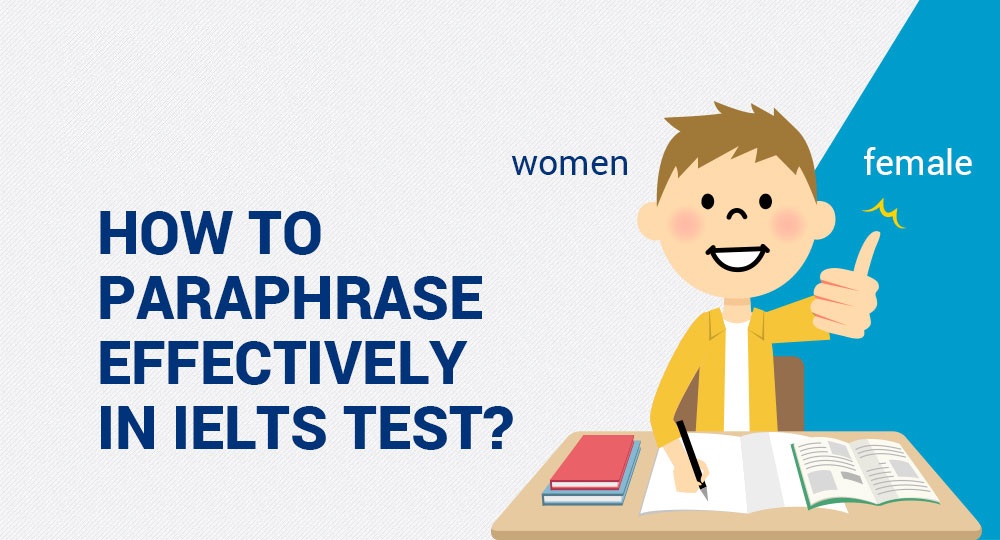
Apart from using idioms for IELTS Writing, paraphrasing is an essential skill in IELTS Writing Task 1. Your introduction should begin by paraphrasing the task question, demonstrating that you understand the prompt and can express the same information in your own words. A well-paraphrased introduction also helps create a clear, original, and appropriate opening for your response.
Leading sentence: To create a successful introduction for your Task 1 response, you should follow a simple but effective process.
How to Paraphrase the Task 1 Question:
| Step | Action | Example |
| 1 | Read the task question carefully | The graph below shows the number of tourists visiting Vietnam between 2010 and 2020. |
| 2 | Identify the key information (what, where, when) | What: number of tourists; Where: Vietnam; When: between 2010 and 2020 |
| 3 | Find synonyms for the key words | graph = chart/illustration/diagram; shows = illustrates/depicts/presents; tourists = visitors; between = from…to…/over a period of |
| 4 | Rewrite the sentence using your synonyms and a different structure | The chart illustrates the number of visitors to Vietnam from 2010 to 2020. |
Leading sentence: You do not need to paraphrase every single word; keeping terms like “bar chart” or “line graph” is perfectly acceptable.
Examples of Paraphrasing Task 1 Questions:
Original Question: “The graph shows the number of visitors to a museum from 2015 to 2025.”
Paraphrase: “The line graph illustrates how many people visited the museum over a ten-year period, from 2015 onwards.”
Original Question: “The maps below show the changes that have taken place in a town centre between 1990 and the present day.”
Paraphrase: “The two maps depict the development of a town centre from 1990 to the current day.”
How to Paraphrase in IELTS Writing Task 2
Paraphrase in IELTS Writing Task 2 is equally crucial. Your introduction should begin with a sentence that paraphrases the essay question. This is your opportunity to demonstrate your lexical resource right from the start.
Leading sentence: A strong introduction sets the tone for your entire essay, and effective paraphrasing is the first step.
A Structured Approach to Paraphrasing Task 2 Questions:
- Read and Understand: Carefully read the question and identify the topic and the task. What is the main issue? What are you being asked to do (e.g., discuss, agree/disagree, suggest solutions)?
- Identify Key Words: Circle the essential words and phrases in the question. These are the concepts you cannot ignore.
- Find Synonyms and Phrases: Think of synonyms and alternative ways to express these key terms. For example, “some people” could become “many individuals” or “a number of citizens.” “Should be free” might become “ought to be provided at no cost.”
- Change the Sentence Structure: Do not just swap words. Change the grammar. Convert an active sentence to a passive one, or vice versa. Combine two clauses into one or split a long sentence into two shorter ones.
- Write Your Paraphrase: Combine your new vocabulary and grammar to create a sentence that says the same thing as the original question but in your own words.
Examples of Paraphrasing Task 2 Questions:
Original Question: “Some people think that the government should spend more money on railways rather than roads. To what extent do you agree or disagree?”
Paraphrase: “A number of individuals believe that public funds should be directed towards rail infrastructure instead of road construction. This essay will discuss the extent to which I support this view.”
Original Question: “Many young people today know more about international pop and film stars than about famous historical figures from their own country. Why is this? What can be done to increase young people’s interest in their own history?”
Paraphrase: “In contemporary society, it is common for young people to have greater familiarity with global celebrities than with significant figures from their own nation’s past. This essay will first examine the reasons for this phenomenon and then propose measures to cultivate a greater appreciation for national history.”
Common Techniques for Paraphrase in IELTS
To become proficient at paraphrasing, you should be familiar with a range of techniques. Using a variety of methods will make your paraphrasing more effective and natural.
Leading sentence: The table below summarises the most effective techniques for paraphrasing in your IELTS preparation.
| Technique | Description | Example |
| Synonym Replacement | Replacing words with synonyms | important → essential / crucial / vital |
| Verb Transformation | Changing the form of a verb | increase (verb) → an increase (noun) |
| Active to Passive | Changing the voice of the sentence | People use the internet. → The internet is used by people. |
| Changing Word Order | Restructuring the sentence | Many people believe… → It is believed by many that… |
| Using Different Clauses | Changing the structure of clauses | …a man who lives in London… → …a man living in London… |
Leading sentence: By practicing these techniques, you can make your paraphrasing more natural and avoid simply swapping synonyms.
See also: 75+ Synonyms & Antonyms for IELTS Writing & Speaking
Recognising Paraphrase in IELTS Reading and Listening
Paraphrase in IELTS is not just a skill for producing language; it is also essential for understanding it. Both the Reading and Listening sections are built around the principle of paraphrasing.
In IELTS Reading, the questions are often a paraphrase of the information in the passage. To find the correct answer, you need to match the meaning of the question to a paraphrased sentence or idea in the text.
Leading sentence: There are several common patterns of paraphrasing you will encounter in the Reading and Listening tests.
Common Paraphrasing Patterns in IELTS Reading & Listening:
| Pattern | Description | Example |
| Synonym Substitution | A word in the question is replaced by a synonym in the passage | Question: a large increase; Passage: a significant rise |
| Antonyms + Negation | An idea is expressed using the opposite word with a negative | Question: not harmful; Passage: safe and beneficial |
| Changing Parts of Speech | A noun in the question is used as a verb in the passage | Question: the growth of the economy; Passage: the economy grew |
| Sentence Restructuring | The information is presented in a different order or with a different grammatical structure | Question: The data was collected by researchers.; Passage: Researchers collected the data. |
Paraphrase in IELTS Speaking
Paraphrase in IELTS Speaking is a valuable skill that demonstrates flexibility and a wide range of vocabulary. It is especially useful when you are discussing a topic and forget a specific word. Instead of pausing or giving up, you can paraphrase to explain your meaning.
Leading sentence: Using paraphrasing in your Speaking test shows the examiner you can communicate effectively, even with a limited vocabulary on a particular topic.
In Part 2 of the Speaking test, you are given a topic card. You should paraphrase the prompt in your introduction. For example, if the card says, “Describe a person you admire,” you could start by saying, “I would like to talk about someone I really look up to…” This demonstrates your ability to use language flexibly from the very beginning.
Common Mistakes to Avoid When Paraphrasing
Many candidates make mistakes when trying to paraphrase. Being aware of these common errors can help you avoid them and improve your score.
Leading sentence: Avoiding these common pitfalls will ensure your paraphrasing is effective and helps rather than hinders your score.
| Mistake | Explanation | How to Avoid |
| Changing the Meaning | Using synonyms that do not accurately convey the original meaning | Always check that your new sentence means exactly the same as the original. |
| Using Inappropriate Synonyms | Choosing a synonym that is not suitable for the context (e.g., using “kids” in a formal essay) | Know the register of the words you use. Academic writing requires formal vocabulary. |
| Over-Paraphrasing | Trying to change every single word, leading to an unnatural or incorrect sentence | Focus on the key ideas. Some terms, like “bar chart,” do not need to be paraphrased. |
| Copying the Question | Not paraphrasing at all and copying the question directly into your introduction | Always rephrase the question using your own words to show your language ability. |
| Making Grammatical Errors | Creating a grammatically incorrect sentence while trying to change its structure | Ensure your new sentence is grammatically sound. If you are unsure, stick to a simpler, correct structure. |
How to Practice Paraphrasing for IELTS
Like any skill, paraphrasing improves with consistent practice.
Leading sentence: Here are some effective ways to practice and master paraphrase in IELTS.
- Practice with Past Questions
Take a past IELTS Writing Task 2 question and practice paraphrasing it. Write down several different versions. This will help you build flexibility and confidence. - Create a Synonym Table
When you encounter a new word, note down its synonyms. For example, for “people,” you could note “individuals,” “citizens,” “the public,” and “residents”. This will give you a pool of words to draw on when paraphrasing. - Read Actively
When you read articles or sample essays, pay attention to how the author paraphrases ideas. Notice the vocabulary and grammatical structures they use. - Rewrite Sentences
Take a simple sentence and try to rewrite it in three or four different ways using the techniques discussed above. Check your work to ensure the meaning remains the same. - Use Official IELTS Materials
Practice with official IELTS materials, such as the Cambridge IELTS books. These will give you authentic examples of the types of questions and passages you will encounter in the test.
Conclusion
Paraphrase in IELTS is a fundamental skill that is essential for success in all four parts of the exam. It is not just about finding synonyms; it is about demonstrating a deep understanding of the English language, a wide range of vocabulary, and the ability to express ideas flexibly and accurately.
By mastering the techniques of paraphrasing and practicing regularly, you can significantly improve your Lexical Resource score in Writing and Speaking, and your ability to understand and answer questions in Reading and Listening. Remember to focus on meaning, use appropriate vocabulary, and avoid common mistakes. With dedicated practice, paraphrasing will become a natural and powerful tool in your IELTS preparation. Visit IELTS Test Pro today to access our complete library of IELTS preparation materials and start your journey to Band 7.0+ now!
