
IELTS Lexical Resource: The Complete Guide to Boosting Your Vocabulary Score
Many IELTS candidates believe that improving their IELTS lexical resource simply means memorizing long lists of difficult words. In reality, examiners are not looking for rare or obscure vocabulary – they are assessing your ability to use a wide range of vocabulary accurately, flexibly, and appropriately in context.
In this comprehensive guide, IELTS Test Pro will explain exactly what IELTS lexical resource means, what examiners expect at each band level, and provide proven strategies to help you boost your vocabulary score in both Writing and Speaking.
See also: IELTS Vocab for Band 7.0+: Essential Vocabulary to Improve Your IELTS Score
What Is IELTS Lexical Resource?
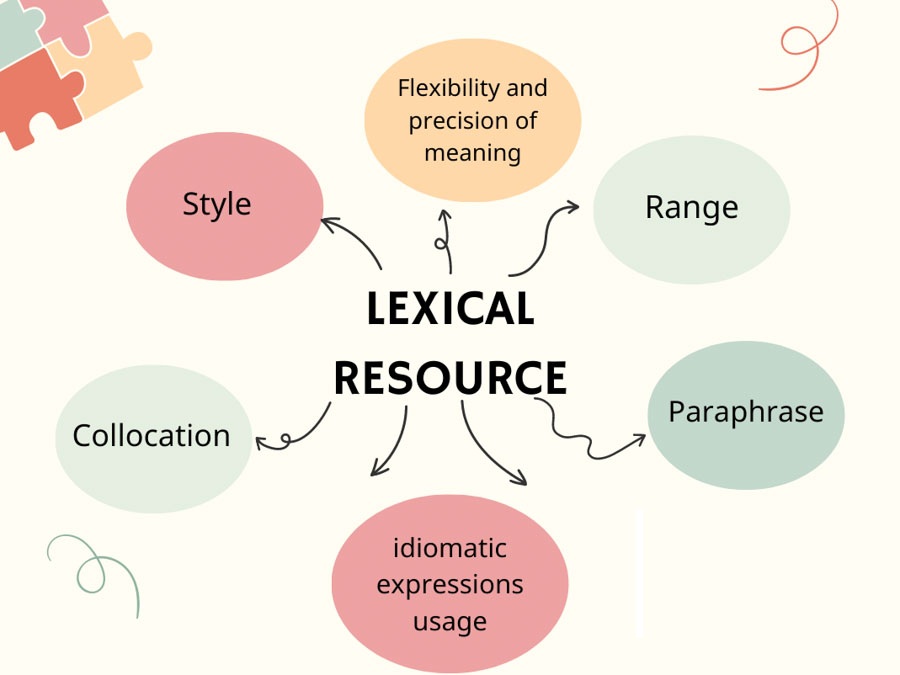
Lexical Resource is one of the four criteria used to assess your IELTS Writing and Speaking performance, accounting for 25% of your total score in each skill. It measures your ability to use a wide range of vocabulary correctly and appropriately.
In simple terms, IELTS lexical resource evaluates:
| Aspect | What It Means |
| Range | The variety of words you use – not repeating the same basic words |
| Precision | Choosing the right word for the right meaning |
| Appropriacy | Using words in the correct context and style |
| Collocations | Combining words naturally (e.g., make a decision, not do a decision) |
| Paraphrasing | Expressing the same idea in different ways |
Key Insight: Lexical Resource is not assessed in isolation – it is closely connected with the other criteria and forms an integral part of your overall performance.
IELTS Lexical Resource Band Descriptors
Understanding what examiners are looking for at each band level is essential for improving your IELTS lexical resource score. Here is a breakdown of the key requirements:
Writing Task 2 Lexical Resource Descriptors
| Band | Lexical Resource Requirements |
| Band 9 | Uses a wide range of vocabulary with very natural and sophisticated control; rare minor errors only as “slips” |
| Band 8 | Uses a wide range of vocabulary fluently and flexibly to convey precise meanings; skilfully uses uncommon lexical items; only occasional errors in word choice |
| Band 7 | Uses a sufficient range of vocabulary to allow some flexibility and precision; uses less common lexical items with some awareness of style and collocation |
| Band 6 | Uses an adequate range of vocabulary; attempts to use less common vocabulary but with some inaccuracy; makes some errors in word choice and spelling |
What Band 7+ Lexical Resource Looks Like?
To achieve Band 7.0+ in IELTS lexical resource, you need to demonstrate:
A sufficient range of vocabulary – not just basic words, but topic-specific and less common terms
Flexibility and precision – choosing words that express your exact meaning
Awareness of style and collocation – using words in natural combinations
Effective paraphrasing – avoiding repetition by expressing ideas in different ways
Rare errors – occasional slips are acceptable, but frequent mistakes will limit your score
Read more: IELTS Writing Tips: The Ultimate Guide for Beginners
How to Improve Your IELTS Lexical Resource
Improving your IELTS lexical resource requires a strategic approach. Here are the most effective methods:
1. Learn Vocabulary by Topic
Instead of memorizing random word lists, focus on vocabulary grouped by common IELTS topics (Education, Technology, Environment, Health, Work, etc.). This makes it easier to recall relevant words during the exam.
Recommended approach:
- Identify 10-12 core IELTS topics
- Learn 15-20 key words and phrases per topic
- Focus on 200-300 topic-specific words total
2. Study Collocations, Not Just Individual Words
Collocations for IELTS are words that naturally go together. Examiners specifically look for your ability to use them correctly.
| Instead of… | Use this collocation |
| make research | conduct research |
| do a decision | make a decision |
| have responsibility | take responsibility |
| get experience | gain experience |
Tip: When you learn a new word, learn the words that commonly accompany it. For example, instead of just learning impact, learn have a significant impact on.
3. Use Different Parts of Speech
A powerful way to demonstrate lexical range is to use different forms of the same word.
| Noun | Verb | Adjective | Adverb |
| environment | to environmental | environmental | environmentally |
| economy | to economic | economic | economically |
| society | to socialize | social | socially |
Example in a sentence: The government should invest (verb) in education. This investment (noun) will bring significant (adjective) benefits, significantly (adverb) improving the quality of life.
4. Learn Paraphrasing Techniques
Paraphrasing is essential for avoiding repetition and demonstrating lexical flexibility. Practice rewriting sentences using different words and structures.
Example:
- Original: Many people believe that technology is beneficial for education.
- Paraphrase 1: Technology is widely considered to be advantageous for learning.
- Paraphrase 2: There is a common view that technological developments have a positive impact on education.
- Paraphrase 3: The benefits of technology in educational settings are increasingly recognized.
See also: How to Paraphrase in IELTS to Boost Your Band Score?
5. Read Widely and Actively
Reading is one of the most effective ways to expand your vocabulary. However, passive reading is not enough – you need to read actively.
Active reading strategy:
- Read IELTS-related texts, newspapers, academic articles, and sample essays
- Highlight unfamiliar words and phrases
- Look up their meanings, collocations, and example sentences
- Record them in a vocabulary notebook with example sentences
- Review and practice using them regularly
6. Build a Daily Vocabulary Routine
Consistency is key to improving your IELTS lexical resource.
Sample daily routine:
- Learn 5-10 new words with example sentences
- Review yesterday’s words
- Read for 15-20 minutes and note new vocabulary
- Practice using new words in a short paragraph or speaking exercise
- Use digital tools like flashcards or vocabulary apps for spaced repetition
7. Practice Using New Words in Context
Simply memorizing words is not enough – you must use them actively. Practice writing essays and speaking responses that incorporate your new vocabulary.
Writing practice:
- Write a Task 2 essay on a topic you have studied
- Challenge yourself to use at least 5-10 new vocabulary items
- Review your essay and identify opportunities to upgrade basic vocabulary
Speaking practice:
- Record yourself speaking on a common IELTS topic
- Listen back and note where you used basic vocabulary
- Practice the same response using more precise and varied vocabulary
See also: 75+ Synonyms & Antonyms for IELTS Writing & Speaking
High-Frequency IELTS Lexical Resource Vocabulary by Topic
To help you build your IELTS lexical resource, here are essential vocabulary items organized by common topics:
Education Vocabulary
Education consistently appears across all IELTS skills. Master these essential terms to discuss educational issues with confidence.
| Word/Phrase | Meaning | Example |
| curriculum | the subjects taught in a school | The national curriculum should include practical life skills. |
| higher education | university-level study | Many students pursue higher education to improve their career prospects. |
| vocational training | job-specific education | Governments should invest more in vocational training. |
| academic performance | educational achievement | Extracurricular activities can positively affect academic performance. |
| lifelong learning | continuous learning throughout life | Lifelong learning is essential in a rapidly changing world. |
Technology Vocabulary
Technology-related topics appear frequently in IELTS Writing and Speaking. Learning these key terms will enable you to discuss technological developments with confidence and precision.
| Word/Phrase | Meaning | Example |
| artificial intelligence | computer systems that perform human-like tasks | Artificial intelligence is transforming many industries. |
| automation | using technology to perform tasks automatically | Automation has led to significant job displacement in manufacturing. |
| digital literacy | ability to use digital technology effectively | Digital literacy is now a fundamental skill for the modern workforce. |
| cutting-edge | the most advanced technology available | Hospitals are investing in cutting-edge medical equipment. |
| cybersecurity | protection of computer systems from attacks | Cybersecurity has become a major concern for businesses. |
Environment Vocabulary
Environmental topics are almost guaranteed to appear in IELTS. These key terms will help you discuss climate change, pollution, and sustainability effectively.
| Word/Phrase | Meaning | Example |
| sustainable development | meeting needs without harming future generations | Sustainable development requires a balance between growth and conservation. |
| carbon emissions | release of carbon dioxide into the atmosphere | Countries must work together to reduce carbon emissions. |
| renewable energy | energy from naturally replenished sources | Investing in renewable energy can help combat climate change. |
| biodiversity | variety of living organisms in an ecosystem | Deforestation is a serious threat to biodiversity. |
| environmental degradation | damage to the environment | Environmental degradation is a pressing global issue. |
Health Vocabulary
Health-related vocabulary is essential for discussing lifestyle choices, healthcare systems, and public health issues in IELTS. Building a strong command of this vocabulary will enable you to express ideas about well-being more naturally.
| Word/Phrase | Meaning | Example |
| sedentary lifestyle | lifestyle with little physical activity | A sedentary lifestyle increases the risk of chronic diseases. |
| balanced diet | diet containing all necessary nutrients | A balanced diet is essential for maintaining good health. |
| mental health | emotional and psychological well-being | Mental health awareness has improved significantly in recent years. |
| life expectancy | average lifespan of a population | Advances in healthcare have increased life expectancy worldwide. |
| preventative healthcare | measures to prevent diseases | Governments should invest more in preventative healthcare. |
Work and Career Vocabulary
Work and career topics are regularly tested in IELTS essays about employment, salaries, and workplace trends. Mastering this vocabulary will help you discuss professional issues with greater precision.
| Word/Phrase | Meaning | Example |
| work-life balance | balance between work and personal life | Many employees prioritize work-life balance over a high salary. |
| job satisfaction | fulfillment from a job | Job satisfaction is linked to higher productivity and employee retention. |
| career advancement | progress in one’s professional career | Professional development opportunities are essential for career advancement. |
| skilled workforce | workers with specialized training | A skilled workforce is crucial for economic competitiveness. |
| job security | likelihood of keeping a job | Job security is a major concern for many employees. |
Government and Society Vocabulary
Government and society topics often appear in IELTS Writing Task 2, especially in essays about public spending, social welfare, and urban development. Developing vocabulary in this area will allow you to discuss policy issues more accurately.
| Word/Phrase | Meaning | Example |
| public expenditure | government spending | Increased public expenditure on infrastructure can stimulate economic growth. |
| social welfare | programs that provide assistance to citizens | Social welfare programs provide a safety net for vulnerable populations. |
| economic growth | increase in a country’s economic output | Sustainable economic growth requires investment in education and technology. |
| infrastructure | basic physical systems of a country | Improving infrastructure is essential for urban development. |
| quality of life | overall well-being of individuals | Urban planning significantly affects the quality of life of residents. |
Common Vocabulary Upgrades for IELTS Lexical Resource
One of the most effective ways to improve your IELTS lexical resource is to replace basic, overused words with more precise and academic alternatives:
| Basic Word | Band 7.0+ Alternative |
| good | beneficial, advantageous, favorable |
| bad | harmful, detrimental, adverse |
| big | significant, substantial, considerable |
| small | minimal, marginal, limited |
| important | crucial, essential, vital, paramount |
| help | assist, facilitate, support |
| show | demonstrate, illustrate, indicate |
| improve | enhance, strengthen, boost |
| get | obtain, acquire, secure |
| use | utilize, employ, adopt |
| problem | issue, challenge, obstacle, dilemma |
| change | alter, transform, modify, shift |
| increase | rise, grow, escalate, surge |
| decrease | decline, reduce, diminish, plummet |
| people | individuals, citizens, residents, population |
| idea | concept, notion, perspective, viewpoint |
| job | occupation, profession, career, employment |
| money | financial resources, funding, capital, revenue |
| think | believe, consider, maintain, argue, contend |
| need | require, necessitate, demand |
Collocations to Boost Your IELTS Lexical Resource
Collocations are a critical component of IELTS lexical resource. Here are essential collocations organized by type:
Verb + Noun Collocations
Verb + noun collocations are among the most important combinations to master for a high IELTS lexical resource score. These natural partnerships demonstrate your ability to use language fluently and accurately, which is exactly what examiners are looking for.
| Collocation | Meaning | Example |
| conduct research | carry out a study | Scientists are conducting research on climate change. |
| make a decision | decide | Governments must make difficult decisions about public spending. |
| take responsibility | accept accountability | Individuals should take responsibility for their health. |
| reach a conclusion | come to a decision | After careful analysis, the committee reached a conclusion. |
| pose a threat | present a danger | Air pollution poses a serious threat to public health. |
| address a problem | deal with an issue | The government must address the problem of unemployment. |
| implement a policy | put a plan into action | Schools are implementing policies to reduce bullying. |
| overcome a challenge | successfully deal with a difficulty | Many countries face challenges in overcoming poverty. |
| achieve a goal | accomplish an objective | Students are motivated to achieve their academic goals. |
| raise awareness | increase knowledge about an issue | Campaigns should raise awareness about environmental issues. |
Adjective + Noun Collocations
Adjective + noun collocations allow you to add precision and sophistication to your writing without using overly complex vocabulary. Mastering these combinations is a straightforward way to enhance your IELTS lexical resource score.
| Collocation | Meaning | Example |
| significant improvement | considerable progress | There has been a significant improvement in living standards. |
| widespread concern | concern felt by many people | There is widespread concern about the impact of social media. |
| critical issue | very important problem | Climate change is a critical issue facing humanity. |
| sustainable development | development that meets current needs | Sustainable development requires international cooperation. |
| substantial investment | large amount of money invested | Substantial investment in infrastructure is needed. |
| rapid growth | quick increase | The population is experiencing rapid growth. |
| major challenge | significant difficulty | Tackling inequality is a major challenge for governments. |
| growing concern | increasing worry | There is growing concern about the state of the environment. |
Adverb + Adjective Collocations
Adverb + adjective collocations add nuance and emphasis to your language, allowing you to express opinions and describe situations with greater precision. These combinations are particularly useful in IELTS Speaking and Writing Task 2 essays.
| Collocation | Meaning | Example |
| highly effective | very successful | The new policy has been highly effective. |
| increasingly important | becoming more important | Technology is becoming increasingly important in education. |
| extremely beneficial | very advantageous | Regular exercise is extremely beneficial for health. |
| widely accepted | accepted by many people | It is widely accepted that education is essential. |
| deeply concerning | very worrying | The rise in unemployment is deeply concerning. |
Common Mistakes That Hurt Your IELTS Lexical Resource
Avoid these common errors to protect your IELTS lexical resource score:
1. Using Words Incorrectly
Using an advanced word incorrectly is worse than using a simple word accurately.
Incorrect: The government should inhabit more money in education.
Correct: The government should invest more money in education.
2. Repeating the Same Words
Repeated use of basic vocabulary signals a limited lexical range.
Repetitive: Education is good. It helps people get good jobs and leads to good economic growth.
Varied: Education is beneficial. It helps people secure rewarding careers and contributes to sustainable economic growth.
3. Using Informal or Inappropriate Language
IELTS Writing and Speaking require appropriate register – formal for Writing, natural for Speaking.
Too informal (Writing): Kids should learn useful stuff at school.
Appropriate (Writing): Children should acquire practical skills at school.
4. Memorizing Words Without Context
Learning vocabulary in isolation often leads to unnatural usage.
Unnatural: The government should implement the environment.
Natural: The government should implement policies to protect the environment.
5. Making Spelling and Word Form Errors
Frequent spelling errors or incorrect word forms limit your lexical resource score.
Error: The enviroment is important.
Correct: The environment is important.
Error: This is a economy issue.
Correct: This is an economic issue.
6. Overusing Idioms and Clichés
While idioms can impress examiners, overusing them or using them incorrectly is detrimental.
Overused: Every coin has two sides. The government should kill two birds with one stone.
Appropriate: There are both advantages and disadvantages. The government should address multiple issues simultaneously.
Read more: Idiom for IELTS Writing: Boost Your Band Score With Idiomatic Language
IELTS Lexical Resource for Writing Task 1 vs. Task 2
Your approach to IELTS lexical resource should differ slightly between Task 1 and Task 2:
Writing Task 1 – Vocabulary Focus
IELTS Writing Task 1 requires a specific set of vocabulary to describe data, trends, and comparisons accurately. The table below outlines the essential vocabulary categories you need to master to achieve a high score in this task.
| Aspect | What to Include |
| Trends | rise, increase, soar, climb, surge / fall, drop, decline, plummet |
| Comparisons | compared to, in contrast, whereas, similar to, significantly higher than |
| Sequence | initially, subsequently, finally, over the period shown |
| Precision | slight, gradual, steady, sharp, dramatic, significant |
Writing Task 2 – Vocabulary Focus
Writing Task 2 demands a broader range of vocabulary to express ideas precisely and academically. Here are the key vocabulary categories you need to master.
| Aspect | What to Include |
| Topic-specific | Education: curriculum, vocational training, academic performance |
| Academic language | furthermore, nevertheless, consequently, in conclusion |
| Precision | detrimental, beneficial, crucial, substantial |
| Paraphrasing | Expressing the same idea in multiple ways |
Topic-Specific Vocabulary
Mastering vocabulary by topic is essential for addressing IELTS questions precisely and demonstrating a wide lexical range.
| Topic | Key Vocabulary |
| Education | curriculum, vocational training, higher education, academic performance, lifelong learning |
| Technology | artificial intelligence, automation, digital literacy, cutting-edge, innovation |
| Environment | renewable energy, carbon emissions, sustainable development, deforestation, biodiversity |
| Health | sedentary lifestyle, balanced diet, mental health, preventative healthcare, life expectancy |
| Work | work-life balance, job satisfaction, career advancement, job security, skilled workforce |
| Government | public expenditure, infrastructure, social welfare, economic growth, quality of life |
| Crime | rehabilitation, deterrence, law enforcement, recidivism, crime prevention |
Academic Language and Linking Words
Linking words are essential for connecting ideas logically. Here are the most useful academic phrases for Writing Task 2.
| Category | Words and Phrases |
| Adding ideas | furthermore, in addition, moreover, additionally |
| Contrasting | however, on the other hand, in contrast, nevertheless |
| Examples | for example, for instance, such as, namely |
| Cause/effect | consequently, as a result, therefore, due to |
| Sequencing | firstly, secondly, finally, subsequently |
| Concluding | in conclusion, to sum up, overall, in summary |
Precise Vocabulary Upgrades
Replacing basic words with more precise alternatives is one of the easiest ways to boost your lexical resource score.
| Basic Word | Band 7.0+ Alternatives |
| good | beneficial, advantageous, favorable |
| bad | harmful, detrimental, adverse |
| important | crucial, essential, vital, paramount |
| big | significant, substantial, considerable |
| small | minimal, marginal, limited |
| help | assist, facilitate, support |
| show | demonstrate, illustrate, indicate |
| improve | enhance, strengthen, boost |
| get | obtain, acquire, secure |
| use | utilize, employ, adopt |
| problem | issue, challenge, obstacle, dilemma |
| change | alter, transform, modify, shift |
| people | individuals, citizens, residents, population |
| think | believe, consider, maintain, contend |
| need | require, necessitate, demand |
Conclusion
Improving your IELTS lexical resource is one of the most effective ways to boost your overall IELTS score. By focusing on topic-specific vocabulary, learning natural collocations, practicing paraphrasing, and avoiding common mistakes, you can demonstrate the range, precision, and flexibility that examiners are looking for.
Remember these key principles:
- Range matters – use a variety of words, not just basic vocabulary
- Precision is essential – choose the right word for the right meaning
- Collocations show mastery – natural word combinations impress examiners
- Practice makes permanent – consistent, active learning is the key to success
At IELTS Test Pro, you will find topic-based vocabulary lists, Band 7.0+ sample essays, collocation guides, and expert strategies to help you master IELTS lexical resource and achieve your target band score.
Start improving your IELTS lexical resource today! Explore our vocabulary resources, practice with real exam questions, and take your IELTS score to the next level with IELTS Test Pro.
