
IELTS Study Plan for Beginners: How to Reach Band 6.5 and Above
Band 6.5 is well within reach, even if you are starting from zero. What usually slows beginners down is not the difficulty of IELTS but the lack of a clear direction. This guide from IELTS Test Pro outlines a practical IELTS study plan for beginners, so you can focus on the right skills at the right time and make steady progress.
What to prepare for an IELTS study plan for beginners
Before you build an IELTS study plan for beginners, take a step back and ask three simple questions: Where am I now? What score do I actually need? And how much time can I study consistently?
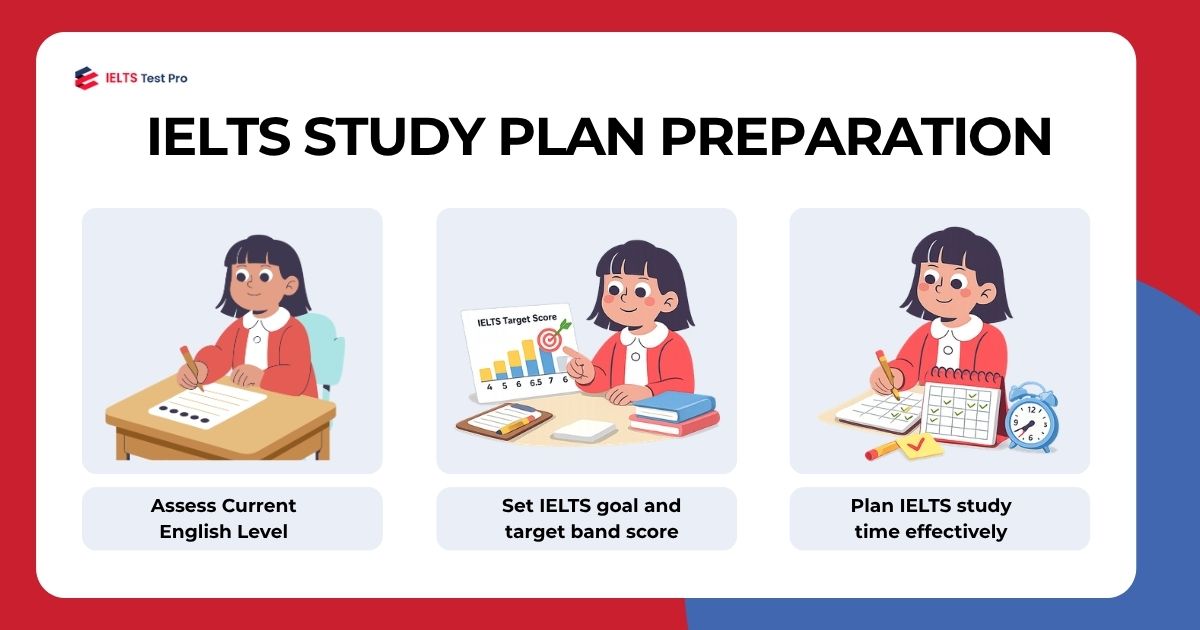
1. Assess Your Current English Level
The first step is to understand your current level as accurately as possible. Most beginners fall into one of these two groups:
- Beginner: limited vocabulary and grammar, unclear pronunciation, little to no exposure to IELTS
- Intermediate: basic English foundation, but lacking IELTS-specific skills and strategies
Not sure exactly where you stand? Take an IELTS Test Pro practice test to quickly identify your strengths and weaknesses before planning your next steps.
2. Set your IELTS goal and target band score
Before setting a target score, you need to choose the right test format for your purpose:
- IELTS Academic is usually required for university admission and study abroad.
- IELTS General Training is used for immigration and work purposes.
Once you know which test you need, compare your current band with your target score. That gap will show how long you may need to study and how intensive your plan should be.
3. Plan your IELTS study time effectively
Set your test date first, then work backward to create a realistic 9-12 month schedule. When planning, think about:
- Your daily or weekly study time
- Possible interruptions such as work, school, or travel
- Whether you can stay consistent over several months
A study plan only works when it fits your actual routine and can be maintained consistently.
Online IELTS study plan from 0 to 6.5+
Stage 1: Building your foundation
At this point in your IELTS study plan for beginners, the focus shifts toward handling real exam tasks with confidence.
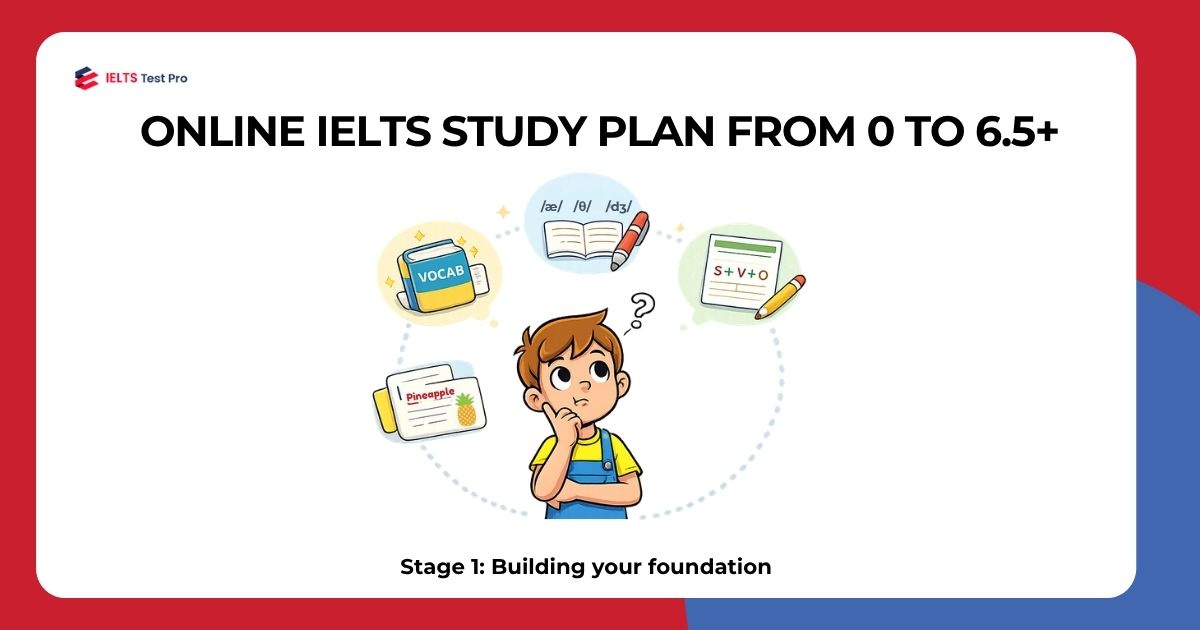
Vocabulary
You need to focus on common IELTS topics instead of learning random words:
- People
- Home
- School & Workplace
- The World
- Leisure
- Technology
- Social Issues
Books like Oxford Word Skills and Vocabulary in Use are effective because they present vocabulary in context. To make your learning more practical, you can also learn vocabulary by topic through IELTS vocabulary practice.
Grammar
Focus on structures that appear frequently in IELTS tasks:
- Tenses
- Parts of speech
- Prepositions
- Relative clauses
- Passive voice
- Comparison structures
A resource such as Cambridge Grammar for IELTS works best when you combine it with consistent practice through IELTS grammar practice.
Pronunciation
If you are a beginner, you should start with IPA and individual sounds to avoid long-term pronunciation errors.
If you are at an intermediate level, you should combine pronunciation with listening practice using common IELTS topics such as names, numbers, and basic academic vocabulary.
Listening and Reading basics
You should become familiar with common question types and core skills:
- Reading: Matching Headings, True/False/Not Given, Matching Information, Summary Completion, Multiple Choice, Table/Diagram Completion
- Listening: Multiple Choice, Form/Table Completion, Map/Diagram Labelling, Short Answer, Matching
At the same time, train two core skills:
- Skimming: quickly identify the main idea of a passage
- Scanning: locate keywords and specific details
Speaking and Writing basics
You should start with Speaking Part 1 topics such as Work, Study, and Hometown to build confidence in answering simple questions. For Writing Task 1, focus on describing basic charts (line, bar, pie) clearly and accurately before moving on to more complex structures.
Stage 2: Improving your IELTS skills
With a basic foundation already in place, this stage of your IELTS study plan for beginners focuses on handling real exam tasks more effectively.
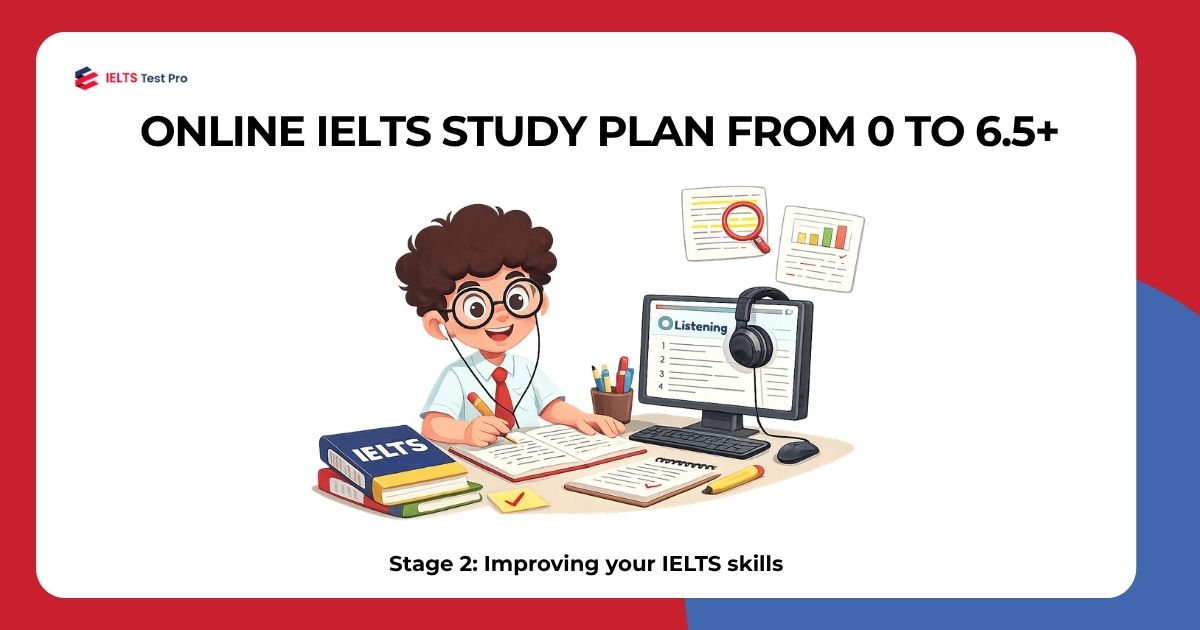
Listening and Reading improvement
At this point, practice starts to shift toward real test materials, especially Cambridge IELTS Practice Tests. What really makes a difference, however, is how each test is reviewed:
- Read the transcript or passage carefully after finishing
- Pay attention to how keywords are paraphrased
- Go back to the exact part where the answer appears
This process gradually improves both accuracy and speed. For more structured practice, IELTS listening practice can be used alongside Cambridge materials.
Writing Task 2 development
At this stage, writing becomes more important because it requires both language control and idea development. Regular practice with essays of at least 250 words is essential, especially on common topics such as:
- Health
- Environment
- Education
- Technology
- Society
Resources like Collins – Get Ready for IELTS Writing and Collins – Writing for IELTS provide useful guidance, while consistent practice through IELTS writing practice helps turn those ideas into habits.
Speaking (Part 2 & 3)
Speaking practice should now move beyond short answers and focus on longer responses and deeper discussion. Common topics include:
- Person
- Event
- Things
- Activities
- Favorites
Key areas to develop include idea organization, fluency within 1-2 minutes, and the ability to extend answers in Part 3. Feedback plays a critical role at this stage.
If direct feedback is not available, using tools like IELTS speaking practice with AI evaluation can help identify weaknesses and track progress more effectively.
Stage 3: Completing your IELTS preparation
The final stage of your IELTS study plan for beginners usually lasts around two months. At this point, the focus shifts to refining performance under real test conditions rather than learning new content.
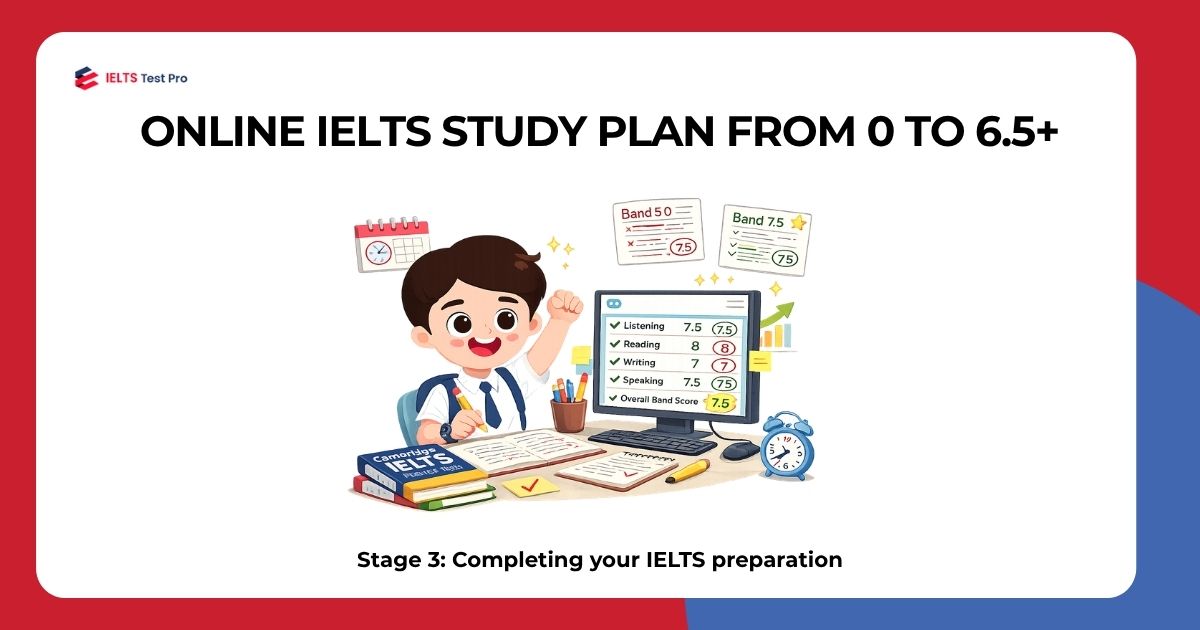
Listening and Reading
Full tests should now become part of your routine. Instead of aiming for more practice, pay attention to patterns in your mistakes and adjust accordingly:
- Track repeated errors
- Improve timing and accuracy
- Focus on question types that still cause confusion
Materials such as Cambridge IELTS and IELTS Fighter are suitable for this phase.
Writing
Practice full tests regularly to strengthen idea depth, vocabulary, and coherence. Comparing band 5.0 and 7.0+ sample answers can help you understand what makes a response more effective.
See also: 9+ IELTS writing tips
Speaking
Practice Part 3 more consistently, focusing on structured answers of 3-5 sentences. At this stage, stronger responses are usually clear, fluent, and supported by logical arguments rather than memorized ideas.
How IELTS Test Pro supports your study plan
A clear IELTS study plan for beginners works best when it is structured, personalised, and easy to follow consistently. Rather than managing multiple resources across different platforms, IELTS Test Pro brings everything into one AI IELTS learning system built around your individual starting point and target band.
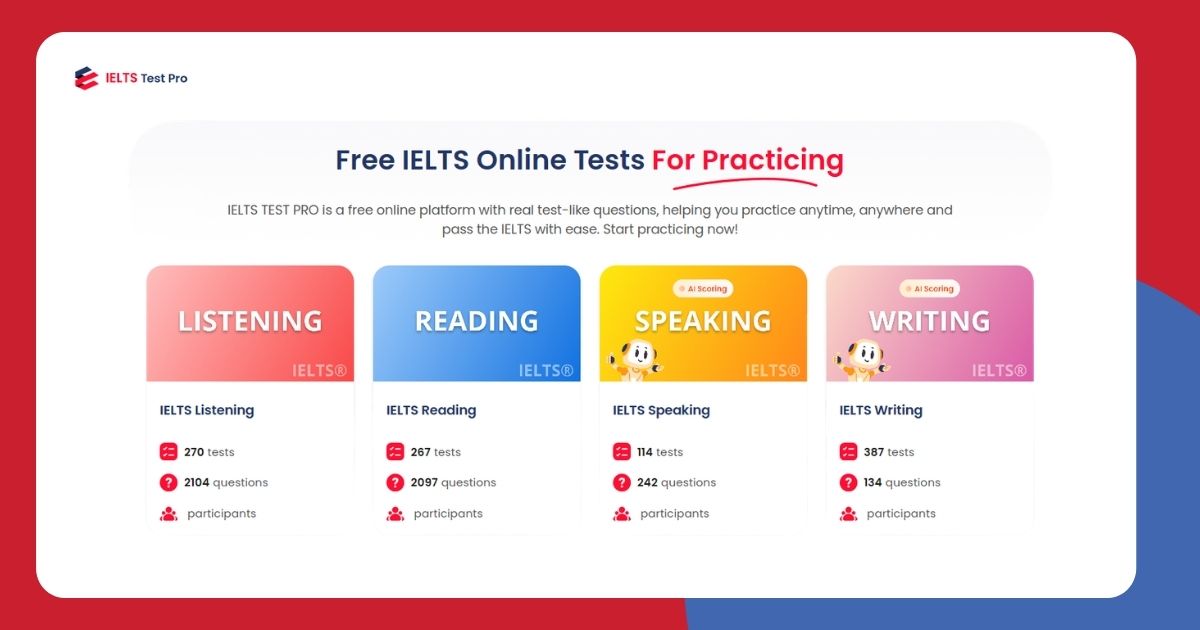
The process begins with a free online IELTS test that assesses your current level across all four skills. From there, the platform’s AI engine analyses your results and generates a personalised study roadmap tailored specifically to you, not a generic plan designed for the average learner.
What your personalised plan includes?
- Free online IELTS test to establish your baseline across Listening, Reading, Writing, and Speaking
- AI-generated study roadmap built around your current level, target band, and available study time
- Structured skill practice aligned with real IELTS formats so every session prepares you for the actual test
- AI IELTS learning feedback for Writing and Speaking, giving you detailed guidance on exactly what to improve after each attempt
- Real-time progress tracking so you can identify weak areas and adjust your plan before they affect your final score
As your scores improve, the AI continuously recalibrates your plan to keep your preparation focused on the skills that matter most at each stage. This means less wasted time, fewer unnecessary retakes, and a faster path to Band 6.5 and beyond.
Start with a free online IELTS test on IELTS Test Pro today and get a personalised AI IELTS learning plan built around your goals from day one.
Conclusion
A clear plan turns IELTS from something overwhelming into something manageable. With the right IELTS study plan for beginners, every step becomes purposeful and measurable. If you want a structured path, guided practice, and real feedback in one place, you can start building your own plan today with IELTS Test Pro.
FAQs
1. How long does it take to go from 0 to 6.5 IELTS?
With a well-structured IELTS study plan for beginners, most learners need around 9-12 months. The exact timeline depends on your starting level, daily study time, and consistency.
2. What is the fastest way to improve IELTS?
The fastest way is to study with a clear plan, practice using real IELTS materials, and review your mistakes carefully. Progress becomes much faster when you combine regular practice with feedback, especially for Writing and Speaking.
