
12 Powerful Diagram Labelling IELTS Reading Strategies to Boost Your Band Score
Many IELTS test takers feel nervous about diagram labelling because of unfamiliar vocabulary and technical terms. However, this question type tests reading strategy more than background knowledge.
You do not need to understand every specialized word. Instead, you need to locate information, recognize paraphrasing, and use the diagram as a guide. Since IELTS Test Pro has previously covered the basics, this article focuses on advanced strategies to improve speed, accuracy, and confidence.
If you want diagram labelling IELTS Reading to become one of your easiest scoring question types, these 12 strategies are a must-know.
Diagram Labelling in IELTS Reading: How It Works
Diagram labelling in IELTS Reading requires you to complete missing labels on a diagram using words from the reading passage. The diagram may show a machine, natural process, biological structure, manufacturing process, or a map and design.
This question type tests scanning skills, keyword recognition, paraphrasing awareness, and your ability to connect visual information with the text. It also checks grammar awareness, since the correct word form often matters.
Many students lose marks by focusing too much on difficult vocabulary or reading the whole passage first. In reality, diagram labelling IELTS Reading is more about strategy than language difficulty. The right approach helps you find answers faster, avoid traps, and improve accuracy.
Read more: IELTS Reading Diagram Labelling Questions
12 Powerful Diagram Labelling IELTS Reading Strategies
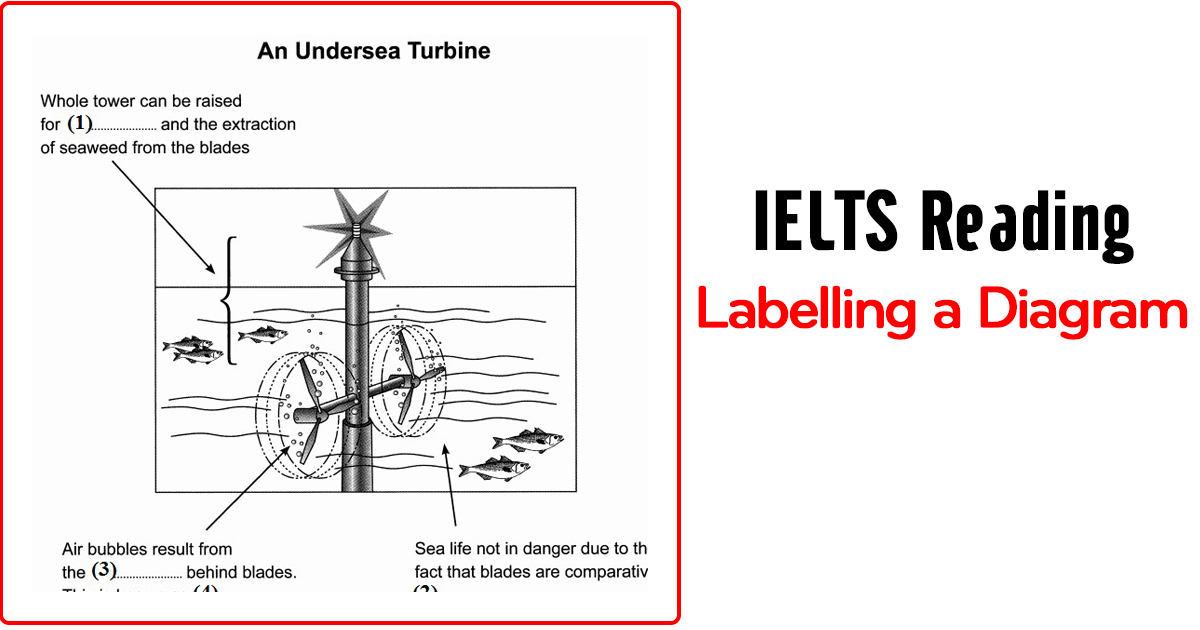
Diagram labelling can become one of the easiest scoring question types in IELTS Reading if you use the right approach. Instead of trying to understand every technical word, focus on strategy. The 12 strategies Diagram labelling IELTS Reading below will help you save time, avoid common traps, and improve your accuracy on test day.
1. Read the Instructions Before Anything Else
Always check the word limit first. For example:
NO MORE THAN TWO WORDS
NO MORE THAN THREE WORDS AND/OR A NUMBER
Even a correct answer becomes wrong if it exceeds the limit. Remember that numbers count as one item, and hyphenated words like “twenty-year-old” also count as one word. Many students lose easy marks by missing this detail.
2. Understand the Diagram Before Reading the Passage
Spend a few seconds understanding what the diagram shows.
Focus on:
- the title
- completed labels
- arrows and flow
- process order
- numbers
- positions of missing labels
This helps you understand the general idea before scanning the text. For example, arrows show sequence, while completed labels reveal the topic. Do not overanalyze-just get enough context to locate answers faster.
3. Use Completed Labels as Clues
Many students ignore completed labels, but they are valuable clues. They help you identify the topic, understand the structure, and predict missing information.
For example, if labels show parts of a machine, you can narrow your search in the passage. These labels often match nearby information in the text and help you find the correct paragraph faster.
4. Predict the Type of Missing Word
Before scanning, predict what kind of word fits the blank. It could be a noun, number, measurement, material, location, or machine part.
For example, after “made of,” the answer is likely a material. Grammar clues around the blank help you remove wrong options quickly and search more accurately.
5. Scan for Keywords, Not Full Sentences
Do not try to read the entire passage when answering diagram labelling questions. Instead, use scanning to quickly search for:
- repeated words
- technical terms
- numbers
- names
- synonyms
This helps you move directly to the relevant part of the text without wasting time on unnecessary details.
For example, if the diagram mentions a specific machine part or process stage, look for that term or its paraphrase in the passage. Numbers and names are especially useful because they are easier to spot and usually remain unchanged.
6. Watch Carefully for Paraphrasing
IELTS rarely repeats the exact same words from the diagram in the reading passage, so you must pay close attention to paraphrasing. For example, the diagram may use the phrase “waste disposal area,” while the passage refers to it as a “landfill site.” Similarly, “cooling system” in the diagram might appear as “temperature control unit” in the text.
You need to recognize meaning, not exact wording. Many students lose marks because they only search for the same phrase instead of understanding synonyms and paraphrasing.
7. Read Before and After the Keyword
Never choose the first similar word you see. IELTS often includes distractors that look correct but are actually wrong.
Always read the sentence before, the target sentence, and the sentence after. The correct answer may be explained nearby, not in the first matching line. Context matters more than individual words.
8. Pay Attention to Position Words
Pay close attention to position words like:
- above
- below
- beside
- connected to
- beneath
- inside
- next to
These words are often critical because they describe exactly where each part is located in the diagram and help you match the correct label.
Even if a word seems correct based on vocabulary, it can still be wrong if it does not fit the physical position shown in the diagram. In diagram labelling, the answer must fit both the text and the structure of the diagram.
9. Trust the Passage, Not Your Own Knowledge
Even if you already know the topic in real life, always use information from the passage only. IELTS Reading tests your ability to find and understand information in the text, not your background knowledge or personal assumptions.
Sometimes the real-world answer may be different from the answer given in the passage. If you rely on your own knowledge instead of the text, you can easily choose the wrong answer. In diagram labelling, the safest rule is simple: always trust the passage, not your memory.
10. Be Careful with Similar Technical Words
Some words look very similar:
- pipe / tube / tunnel
- root / trunk / stem
- tank / container / chamber
Only one is correct. To choose accurately, focus on both location and function. For example, a pipe may carry liquid, while a chamber may be a space where a process happens. The correct answer depends on how that part is described in the text and where it appears in the diagram. Never guess just because a word feels familiar-small differences in meaning can easily lead to lost marks.
11. Skip Difficult Questions and Return Later
Do not get stuck on one difficult blank for too long. If a question is taking too much time, move to the next one and return later. Spending too long on a single answer can hurt your overall performance because it reduces the time available for the rest of the passage.
In many cases, another answer later in the diagram or passage can help you understand the missing one. Additional context often makes the difficult blank much clearer when you come back to it. Good time management is an important part of your IELTS Reading score, so staying flexible and moving forward is often the smarter strategy.
12. Double-Check Spelling and Word Limit
At the end, review every answer.
Check:
- spelling
- singular/plural form
- exact wording
- grammar fit
- word count
Always leave a few seconds at the end to review every answer carefully. Even if you found the correct information, a small mistake can still cost you the mark. In diagram labelling questions, spelling accuracy is especially important because many answers include unfamiliar technical words that are easy to misspell.
Diagram Labelling IELTS Reading Strategies Summary Table
| Strategies | Why It Matters |
| Read instructions first | Avoid word limit mistakes |
| Understand the diagram | Build context quickly |
| Use completed labels | Strong location clues |
| Predict word type | Better grammar accuracy |
| Scan for keywords | Faster answer finding |
| Recognize paraphrasing | Prevent false negatives |
| Read surrounding sentences | Avoid distractors |
| Notice position words | Match diagram location |
| Trust the passage only | Prevent logic mistakes |
| Compare similar terms | Avoid technical confusion |
| Skip difficult blanks | Better time management |
| Double-check answers | Protect easy marks |
Conclusion

Diagram Labelling IELTS Reading becomes much easier once you stop treating it as a vocabulary test and start treating it as a strategy test.With the right techniques, this question type can become one of the fastest and safest ways to gain marks in IELTS Reading. The key is not reading harder-it is reading smarter.
If you want more IELTS Reading strategies, expert breakdowns, and band 7+ practice lessons, start learning with IELTS Test Pro and make every question type easier to master.
