
IELTS Bar Chart: The Ultimate Writing Task 1 Guide
Mastering the specific requirements of each chart type is crucial for success in the IELTS Writing exam. Among the various visual data forms, the IELTS Bar Chart is a frequent occurrence that demands a clear understanding of comparison and trend analysis. This guide by IELTS-Testpro provides a detailed overview and actionable tips to help you conquer this task.
1. Introduction to IELTS Bar Chart Writing Task 1
Bar chart or Bar graph, in IELTS Writing Task 1, share several similar features with Line chart which has two axes (x-axe and y-axe). This feature helps people see how a trend has changed over time. On the other hand, instead of lines, IELTS Bar chart Writing Task 1 contains rectangular bars in horizontal or vertical orientation that illustrate the ratio of each category.
Being a visual representation of data using bars, bar graphs aim to simplify the data and show the difference between volumes and things of categories more easily.
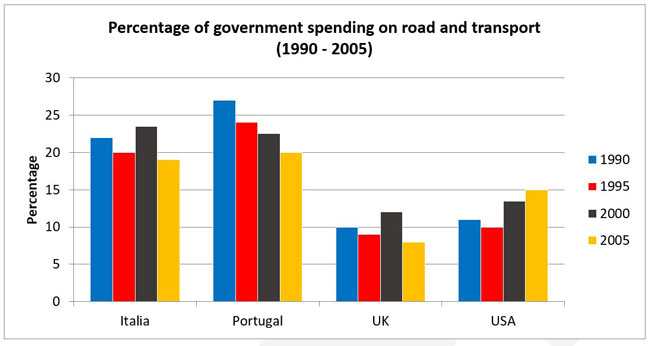
These are some examples for IELTS Bar chart Writing Task 1:
II. Structure of IELTS Bar Chart Writing Task 1
To write a high-scoring essay for an IELTS Bar Chart, it is essential to adhere to a coherent structure. A well-organized response ensures that the examiner can follow your analysis without confusion. Specifically, your essay should be divided into four distinct parts:
1. Introduction
In this very first part, your objective is to introduce the chart to the reader. You need to take the following criteria into account from the question prompt:
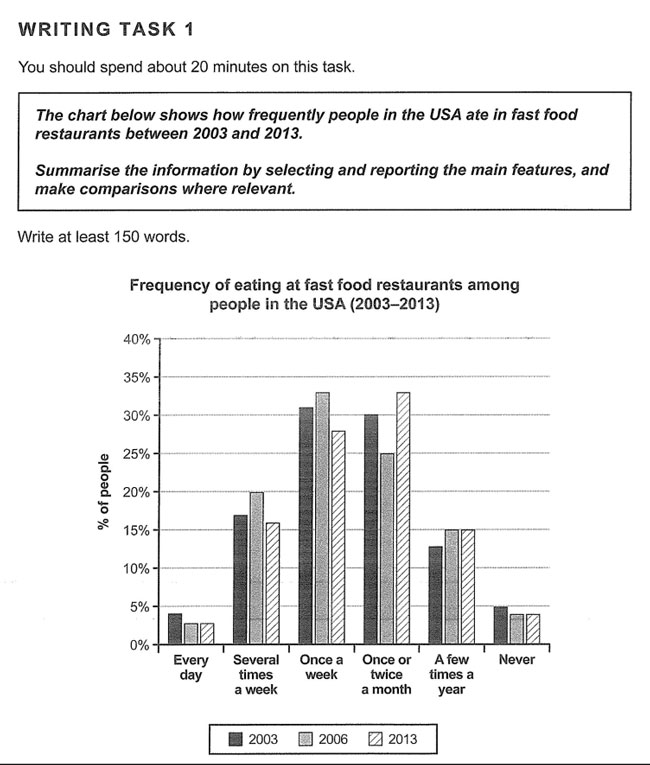
- Topic: What is the chart about? (e.g., the frequency of eating at fast food restaurants).
- Place: Where is the data from? (e.g., the USA).
- Time period: When was the data collected? (e.g., 2003-2013).
- Unit of measurement: How is the data expressed? (e.g., % of people, millions of dollars).
Once you have identified these elements, you must paraphrase the information given in the prompt using your own words. This should be concise, typically taking up about one or two sentences.
- Example: “The bar chart compares the proportion of Americans who had meals at fast food eateries in three separate years (2003, 2006, and 2013).”
2. Overview
The Overview is arguably the most critical paragraph in Task 1. Here, you need to identify and describe the general trend of the graph as well as highlighted features such as the highest and lowest figures, or any data points that remained stable. This part should summarize the main message of the chart without getting lost in specific data details, typically in approximately 1 to 3 sentences.
- Example: “Overall, most Americans went to fast food restaurants once a week between 2003 and 2006, while this frequency shifted to once or twice a month in 2013. Conversely, people eating fast food daily accounted for the lowest percentage across all three years.”
3. Body
The detailed analysis occurs in the Body paragraphs. As per standard practice, you should separate this part into two distinct paragraphs that describe specific details of the bar chart supported by data. Each paragraph should consist of roughly 3 to 4 sentences.
There are two effective ways to split up the body paragraphs to ensure logical flow:
- Group by Trend: Group comparison items together based on their trajectory (e.g., Paragraph 1 describes items with an increasing trend; Paragraph 2 describes those with a fluctuating or decreasing trend).
- Group by Category: Each body paragraph describes the data of a specific category found on the axis (e.g., grouping by country, gender, or city).
>>> Read more: IELTS writing task 1 line graph
III. Steps to write an IELTS Bar Chart Writing Tasks 1 essay effectively
Writing a successful report requires a systematic approach. Follow these four steps to ensure you cover all requirements efficiently.

1. Step 1: Analyse the Question
Before writing a single word, spend time analyzing the prompt. When reading the question, identify and underline these key features:
- Brief description of the chart: Understand the subject matter (e.g., “The bar chart below shows the expenditure that people in two different countries spent on consumer goods in 2010”).
- Type of the chart: Is it a bar chart, line chart, table, or pie chart? Is it a dynamic chart (showing changes over time) or a static chart (showing data at a single point in time)?
- Requirements: Note the standard instruction: “Summarise the information by selecting and reporting the main features, and make comparisons where relevant.”
The task asks you to select and report, not to list every single number. Remember to pick out only the key features that are outstanding. Also, keep the constraints in mind: you should spend approximately 20 minutes to complete Task 1 with a minimum of 150 words.
2. Step 2: Point Out Main Features of the Bar Graph
Once you understand the task, examine the chart to extract the data you will write about. You need to answer these questions to form your plan:
- What information do both the horizontal and vertical axes provide?
- What is the period of time? (This determines the tense you will use).
- What are the most outstanding features (peaks, troughs, stability)?
- Are there any similarities or striking contrasts among the categories?
- How should you group the data for the Body paragraphs?
Now that you have a plan, you are ready to begin your essay.
3. Step 3: Write the Essay
Draft your response following the structure outlined previously. Remember that the standard structure includes 4 paragraphs:
- Paragraph 1: Introduction (Paraphrase the question).
- Paragraph 2: Overview (General trends).
- Paragraph 3: 1st Body Paragraph (Detailed features of group A).
- Paragraph 4: 2nd Body Paragraph (Detailed features of group B).
4. Step 4: Re-check Your Essay
Never skip the review stage. Ensure that you won’t lose any points for careless errors such as incorrect spellings or ungrammatical structures. Take a moment to double-check your IELTS Bar Chart Writing Task 1 before moving on to Task 2.
➡️➡️ See more: IELTS Writing Practice Test
IV. IELTS Bar Chart Writing Tasks 1 Tips
To maximize your band score, consider these expert tips specifically for Bar Charts.

1. Making the most of transition words
Throughout the essay, you need to continuously use linking words to maintain the connection among ideas. Use those words properly, suitably and your score will be higher.
Apart from some linking words like Next, Besides, In addition, etc., you should use other in-between linking words such as compared to, in comparison with, opposing, whereas, while, etc.
2. Be careful with word and time limit
You will have a total of 60 minutes for the IELTS Writing test, so try to spend around 20 minutes for the IELTS Writing Task 1. Also, with the requirement of at least 150 words, you need to write the task with three parts (Introduction, Overview, and Body).
3. Don’t express your point of view
IELTS Bar Chart Writing Task 1, as well as other types of Academic Writing Task 1, will be a task of describing or illustrating a graph, so there will be no personal opinions given on the task.
4. Use proper vocabulary and grammar
A wide range of vocabulary and sentence structures will be an advantage for your IELTS Bar chart Writing Task 1 essay, which can boost your lexical score. To consult more vocabulary for IELTS Task 1, please visit this article IELTS Academic Writing Task 1 on our web.
IELTS Bar Chart Writing Task 1 will no longer be a barrier for you if you prepare enough for the test and practice as much as possible. With IELTS TEST PRO, you can refer to a variety of model samples and useful tips for you to deal with this type of chart in IELTS Writing Task 1.