
Minimum IELTS Score for Immigration by Different Countries
Your immigration plan can come down to a number… your IELTS score. A gap of 0.5 can mean missing a visa threshold or gaining valuable points in a competitive pool. This guide from IELTS Test Pro breaks down the exact IELTS score for immigration in popular countries and shows how to hit your target efficiently the first time.
Why IELTS matters for migration
If immigration is your goal, IELTS is often part of the process from the very beginning, especially when your application is assessed on language ability.
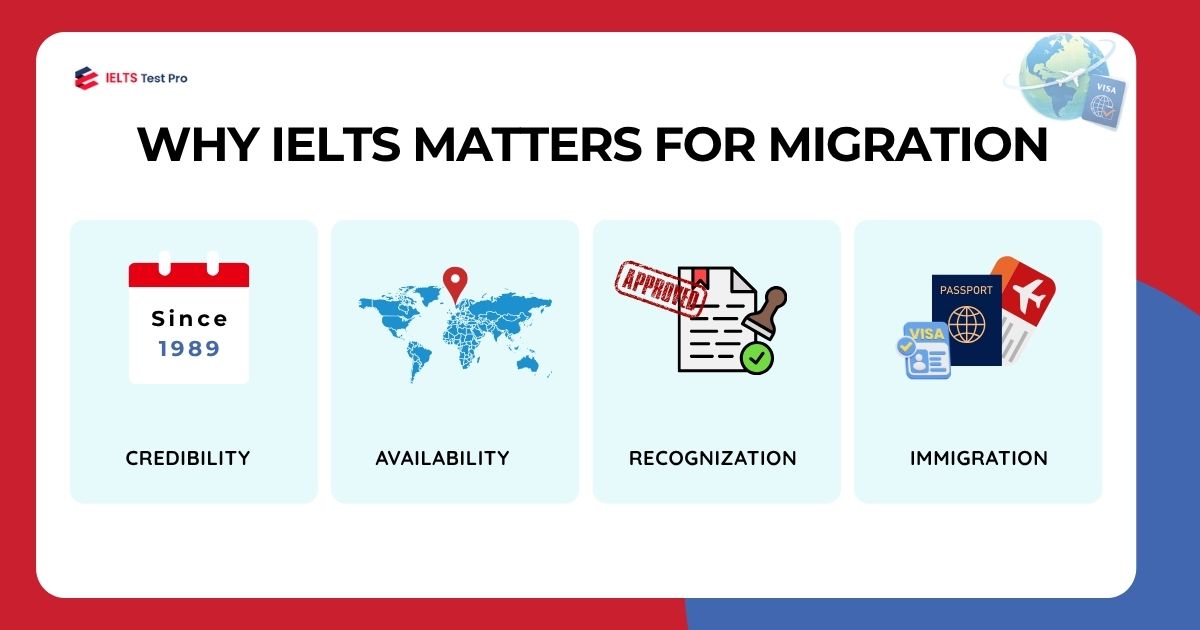
- Long-standing credibility: IELTS has been used for migration purposes since 1989, giving immigration authorities a consistent way to evaluate English skills.
- Available worldwide: You can take IELTS through thousands of locations across 140 countries, so it fits applicants in almost any region.
- Recognised at scale: More than 12,500 organisations accept IELTS, including governments, employers, and professional bodies.
- Built into immigration systems: Many visa pathways require IELTS scores as official proof of English for work, settlement, or permanent residence.
Which IELTS test should you take for immigration?
Which IELTS test does your visa pathway actually require? That’s the first decision to get right before you register.

- IELTS General Training: Commonly required for migration to countries like Canada, Australia, New Zealand, and the UK. It reflects practical English used in everyday situations, work, and social contexts.
- IELTS Academic: Typically needed if your migration route involves higher education or professional registration (e.g., healthcare, engineering), where academic English is required.
Read more: IELTS Academic and General
Minimum IELTS score for immigration in popular countries
How high does your IELTS score need to be for immigration? The answer depends on how each country evaluates English within its immigration system. In most cases, IELTS is tied to a points-based framework, where a minimum threshold (often around Band 6.0 per skill) is required to qualify, and higher scores can strengthen your profile.
Here is an overview of the required IELTS score for immigration in popular destinations:
| Country | Minimum IELTS score for immigration |
| Canada | At least 6.0 in each skill (CLB 7) for many Express Entry pathways |
| Australia | At least 6.0 in each skill (Competent English); 7.0-8.0 increases points |
| United Kingdom | At least CEFR B1 (≈ IELTS for UKVI 4.0 in each skill), depending on visa |
| New Zealand | At least overall 6.5 for most skilled migration routes |
| United States | Typically overall 6.5-7.0 for visa categories requiring proof of English |
| Germany | Typically CEFR B1-B2 (≈ IELTS 5.5-6.5) depending on visa type |
| Ireland | Typically overall 6.0-6.5 for work and residency-related pathways |
| Singapore | Typically overall 6.0+ for skilled migration; 5.5-6.5 for study routes |
| United Arab Emirates | Typically overall 5.0-6.5 depending on role or residency type |
| Hong Kong | Typically overall 6.5+ (QMAS) for skilled migration schemes |
| Netherlands | Typically CEFR B1-B2 (≈ IELTS 5.5-6.5) depending on visa type |
| Sweden | Typically no fixed IELTS requirement; depends on pathway |
| Norway | Typically CEFR B1-B2 (≈ IELTS 5.5-6.5) depending on permit |
| Denmark | Typically overall 5.0-6.0 for work schemes; 6.5-7.0 for higher education/professional roles |
| Finland | Typically overall 6.0-6.5 (B2 level) depending on university/employer requirements |
| Switzerland | Typically overall 5.5-6.5 for most programs; up to 7.0+ for top universities |
| France | Typically overall 6.0-7.0 for English-taught programs or skilled roles |
| Spain | Typically no fixed IELTS requirement; Spanish proficiency usually required |
| Italy | Typically overall 5.5-6.5 for university-based immigration pathways |
| Portugal | Typically no fixed IELTS requirement for general immigration |
| Austria | Typically CEFR A2-B1 (≈ IELTS 3.0-5.0) for points-based residence permits |
| Poland | Typically overall 5.5-6.5 (B2 level) depending on program |
| Czech Republic | Typically overall 5.5-6.0 (≈ B2 level) depending on pathway |
| Hungary | Typically overall 5.5-6.5 for work or study pathways |
| Greece | Typically overall 5.0-6.0 depending on visa type |
| Japan | Typically no fixed IELTS requirement; depends on employer/program |
| South Korea | Typically overall 5.5-6.5 depending on visa type |
| Malaysia | Typically overall 5.5-6.5 depending on study level |
| Thailand | Typically no fixed IELTS requirement for most visas |
| Turkey | Typically overall 5.0-6.5 depending on program or visa type |
How to prepare for IELTS for immigration
Preparation for IELTS for immigration should be built around your target score and visa requirements. A focused strategy helps you reach the required band faster and avoid unnecessary retakes.

- Test format selection: Check whether your pathway requires IELTS General Training or Academic. Immigration systems only accept specific formats, so choosing correctly from the start is essential.
- Score requirement alignment: Work towards the exact threshold first (e.g., CLB 7 for Canada or Band 7.0+ for Australia). Once you consistently reach that level, then aim higher to increase your profile strength.
- Full test simulation: Take regular full-length tests to measure your real performance under exam conditions. You can do this here.
- Time management control: Many candidates lose marks due to poor pacing. Train yourself to complete each section within strict time limits.
- Weakness prioritisation: Instead of studying everything, focus on the skill that is holding your score back and improve it systematically.
- Performance tracking: Keep track of your scores across tests to ensure steady progress towards your immigration requirement.
- Unnecessary retakes avoiding: Many candidates retake IELTS not because of low ability, but because their preparation is not aligned with the required score.
Take a Free Online IELTS Test and Let AI Build Your Immigration Study Plan
Knowing your target score is only half the battle. Getting there efficiently without unnecessary retakes is what determines whether your immigration timeline stays on track.
IELTS Test Pro offers a free online IELTS test that does more than measure where you stand today. Once you complete your diagnostic, the platform’s AI engine analyses your results and automatically generates a personalised study roadmap built around your exact immigration requirement whether that is CLB 7 for Canada, Band 6.0 for Australia, or a higher threshold to strengthen your points profile.
What you get from day one:
- AI-generated study roadmap tailored to your target band and visa deadline
- Personalised weak-point diagnosis across all four skills after your free test
- Adaptive practice sessions that recalibrate automatically as your score improves
- Real-time progress tracking mapped directly to your immigration threshold
- Score-focused exercises aligned to real visa requirements, not generic band descriptors
Unlike generic preparation materials, IELTS Test Pro adapts as you improve so every session moves you closer to your immigration goal with no wasted effort.
Start with a free online IELTS test on IELTS Test Pro today, and let the platform show you the most direct path to your immigration score.
Conclusion
Your IELTS score for immigration can decide how far your application goes. A clear target and focused preparation make that result far more predictable. For a faster, more efficient path to your required score, you can practise with IELTS Test Pro and focus only on what improves your IELTS score for immigration.
FAQs
1. Is IELTS General Training or Academic better for immigration?
IELTS General Training. This is the standard requirement for immigration to countries like Canada, Australia, New Zealand, and the UK.
2. Is IELTS 6.0 enough for immigration?
Yes, in many cases. A minimum of 6.0 in each skill meets basic requirements (e.g., Canada CLB 7, Australia Competent English), but 7.0+ is usually needed to stay competitive.
3. Which country has the easiest IELTS requirement for immigration?
The United Kingdom. Many visa routes only require CEFR B1 (around IELTS 4.0 in each skill), which is lower than most other immigration systems.
