
IELTS for UK universities required band scores in 2026
Not all IELTS scores are treated the same when applying to UK universities. A 6.5 might be enough for one course, yet fall short for another, especially when section scores come into play. This guide breaks down IELTS for UK universities in 2026, so you know exactly what top institutions expect and how to plan your score strategically.
Why IELTS for UK universities matters
Before looking at exact score requirements, it helps to understand why IELTS is non-negotiable for UK study.
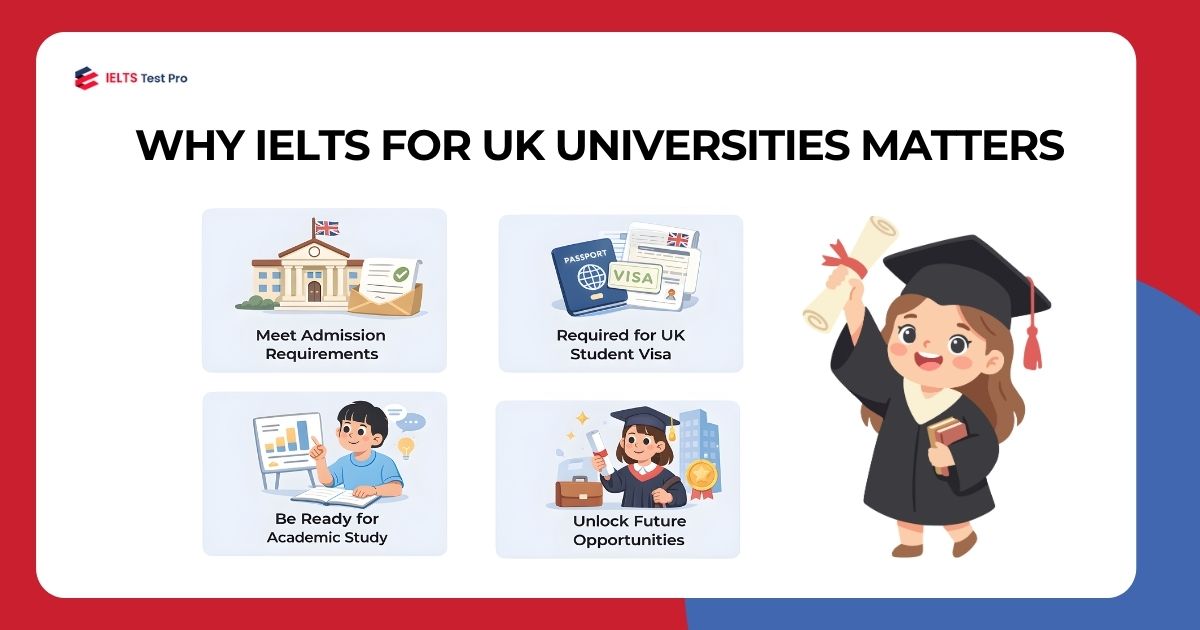
- University admission requirement: Most UK universities use IELTS as a standard benchmark to assess whether you can study in English. Each course sets its own minimum band and section scores.
- Academic readiness: A valid score shows you can follow lectures, write structured essays, and contribute to discussions at the university level.
- Visa support: IELTS for UKVI is commonly required to meet UK visa regulations and prove your English proficiency officially.
- Future opportunities: Many employers and postgraduate programs in the UK still ask for IELTS, so your score can continue to support applications beyond university.
IELTS for UK universities minimum score requirements at top institutions
If you’re aiming for the UK, one mistake many applicants make is focusing only on the overall band. In reality, top universities set both overall and section thresholds, and these can vary more than you expect depending on the course and level of study.
Here’s a detailed overview of IELTS for UK universities’ requirements across top-ranked institutions in 2026.
| Institution | QS Ranking 2026 | Undergraduate IELTS Requirement | Postgraduate IELTS Requirement |
| Imperial College London | 2 | 6.5 overall, no component below 6.0 | 6.5 overall, no component below 6.0 |
| University of Oxford | 4 | 7.5 overall, at least 7.0 in each component | 7.0 overall, no band below 6.5 |
| University of Cambridge | 6 | 7.5 overall, no less than 7.0 in each component | 7.0 overall, no band below 6.5 |
| UCL | 9 | 6.5 overall, at least 6.0 in each component | 6.5 overall, at least 6.0 in each component |
| King’s College London | 31 | 6.5 overall, no band below 6.0 | 7.0 overall, no band below 6.5 |
| University of Edinburgh | 34 | 6.5 overall, no band below 6.0 | 6.5 overall, no band below 6.0 |
| University of Manchester | 35 | 6.0 overall, no less than 5.5 in any component | 6.5 overall, no band below 6.0 |
| University of Bristol | 51 | 6.5 overall, no band below 6.0 | 6.5 overall, no band below 6.0 |
| LSE | 56 | 7.0 overall, no band below 6.5 | 7.0 overall, no band below 7.0 |
| University of Warwick | 74 | 6.5 overall, no band below 6.0 | 7.0 overall, no band below 6.5/6.0 |
| University of Birmingham | 76 | 6.5 overall, no band below 6.0 | 6.5 overall, no band below 6.0 |
| University of Glasgow | 79 | 6.5 overall, no band below 6.0 | 6.5 overall, no band below 6.0 |
| University of Leeds | 86 | 6.0 overall, no band below 5.5 | 6.0 overall, no band below 6.0 |
| University of Southampton | 87 | 6.5 overall, no band below 6.0 | 6.5 overall, no band below 6.0 |
| University of Sheffield | 92 | 6.0 overall, at least 5.5 in each component | 6.5 overall, no less than 6.0 in each component |
| Durham University | 94 | 6.5 overall, no band below 6.0 | 7.0 overall, no element below 6.5 |
| University of Nottingham | 97 | 6.5 overall, no band below 6.0 | 6.0 overall, no less than 5.5 in any element |
| Queen Mary University of London | 110 | 6.0 overall, no band below 5.5 | 6.5 overall, no band below 6.0 |
| University of St Andrews | 113 | 6.5 overall, no band below 6.0 | 6.5 overall, no band below 6.0 |
| University of Bath | 132 | 6.5 overall, no band below 6.0 | 6.5 overall, no band below 6.0 |
See also:
IELTS for UK universities and equivalent English test scores
Not every UK university requires IELTS specifically. In many cases, you can meet the English language requirement through other recognised qualifications, as long as they match the expected level.
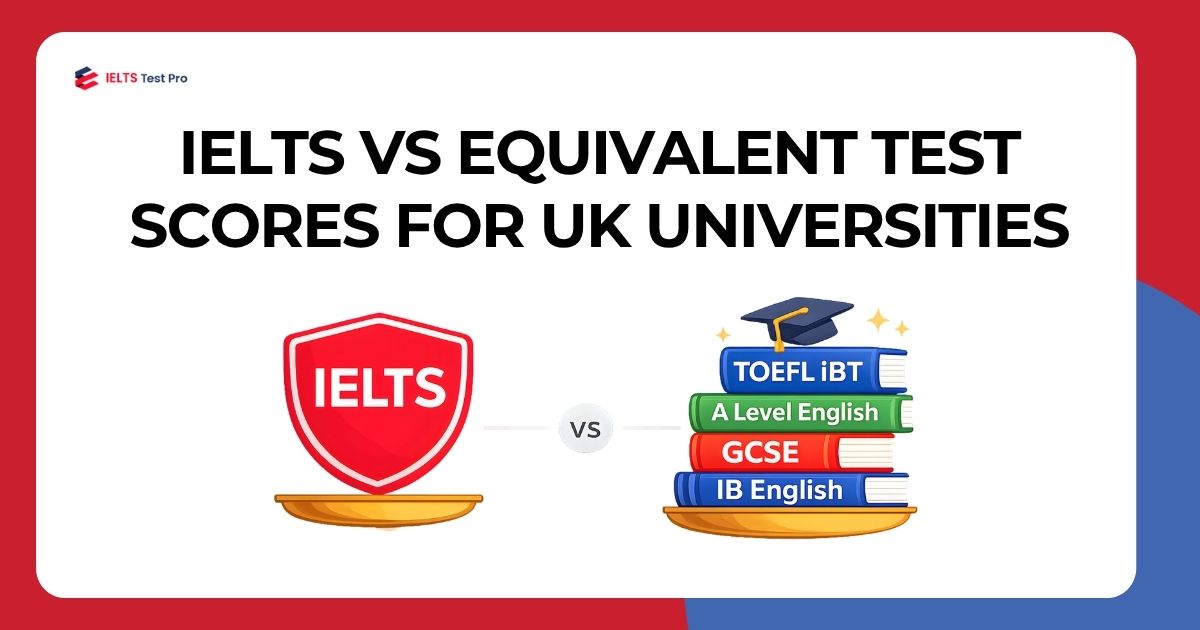
Common alternatives include TOEFL iBT, A Level English, GCSE English, and IB English, with scores aligned to IELTS bands as follows:
| Qualification | IELTS 5.0 | IELTS 5.5 | IELTS 6.0 | IELTS 6.5 | IELTS 7.0 | IELTS 7.5 |
| A Level English | D | D | C | C | B | B |
| GCSE English | D | D | C | C | B | B |
| IB English | Varies by subject and level | Varies by subject and level | Varies by subject and level | Varies by subject and level | Varies by subject and level | Varies by subject and level |
| TOEFL iBT | 60 | 70 | 80 | 90 | 100 | 110 |
While these equivalents are widely accepted, exact requirements still vary by university and programme. It’s always best to check the official course page to confirm which qualifications are accepted and how they are assessed.
Tips to reach the IELTS requirements for UK universities
Once you know your target score, the real challenge is reaching it efficiently, especially when both overall and section bands matter.

Check exact requirements early
Do not assume that one score fits all programmes at the same university. A Business course at the University of Warwick may require 6.5 overall with no band below 6.0, while a Law or Medicine programme at the same institution can set a higher threshold. Always go directly to the official course page, not just the university’s general English language requirements, and note both the overall band and any section minimums before you begin preparing.
Balance overall and section scores
Many candidates focus entirely on lifting their overall band without paying attention to individual skill scores. This is one of the most common reasons for a failed application despite a seemingly acceptable total. If your university requires no band below 6.0 and your Writing sits at 5.5, your application will not meet the requirement regardless of your overall score. Treat each skill as a separate target and track them independently throughout your preparation.
Focus on academic skills
IELTS Academic tests a specific type of English that reflects university-level study. Listening tasks involve lectures and discussions, not everyday conversation. Reading passages are dense and argument-driven. Writing requires structured, formal responses that demonstrate critical thinking. Speaking is assessed on coherence and range, not just fluency. Aligning your practice to these academic contexts from the start will make your preparation far more relevant to what the test actually rewards.
Build academic language
Vocabulary and grammar accuracy have a direct impact on your Writing and Speaking band scores, and indirectly affect how well you perform in Reading and Listening. Rather than learning random word lists, focus on topic areas that appear frequently in IELTS Academic, such as education, technology, environment, health, and society. Practise using precise, formal language in your writing and avoid informal expressions that lower your lexical resource score.
Use mock tests strategically
Taking a full-length practice test once and reviewing your answers is not enough. Use mock tests to simulate real exam conditions, including strict time limits, no interruptions, and handwritten responses for Writing where possible. After each test, analyse not just your total score but which question types you consistently lose marks on. This turns each practice test into a diagnostic tool rather than a simple score check.
Target high-impact skills
Writing Task 2 and Speaking are the two skills that most frequently hold candidates back from higher bands, partly because they require active production rather than recognition, and partly because improvement is harder to measure without external feedback. For Writing Task 2, focus on essay structure, coherence, and argument development rather than length. For Speaking, work on extending your answers with reasons and examples rather than giving short, safe responses. Both skills improve significantly with structured, repeated practice under feedback.
Get a personalised study plan with IELTS Test Pro
Knowing what to improve is one thing, but having a system that guides you through it efficiently is what makes the real difference. IELTS Test Pro offers a free online IELTS test that analyses your performance across all four skills and automatically builds a personalised study roadmap tailored to your specific university requirement, whether that is 6.5 for UCL, 7.0 for LSE, or 7.5 for Oxford and Cambridge.
Unlike generic preparation materials, the AI-powered platform continuously recalibrates your plan as your scores improve, so every session is focused on closing the exact gap between where you are and where your university needs you to be. What your personalised plan includes:
- Free diagnostic test to identify exactly which skills are holding your score back
- AI-generated study roadmap tailored to your target university and band requirement
- Section-level focus on Writing, Speaking, Listening, and Reading separately
- Adaptive practice sessions that adjust automatically as your weaker skills improve
- Real-time progress tracking mapped to your exact university threshold
Start with a free online IELTS test on IELTS Test Pro today and get a personalised path to the exact band your UK university requires.
Conclusion
A few tenths of a band can decide your offer, that’s how precise IELTS for UK universities can be. The goal isn’t just to “get a score,” but to hit the exact requirement your course expects. With the right strategy and consistent practice, that gap is absolutely manageable. For a more focused approach, explore IELTS Test Pro for realistic mock tests and AI feedback that help you improve where it actually matters.
FAQs
1. Do UK universities consider individual IELTS section scores?
Yes. Most UK universities set minimum scores for each skill (Listening, Reading, Writing, Speaking), not just the overall band. Failing one section can affect your offer even if your total score is high.
2. Can TOEFL replace IELTS for UK universities?
Yes. Many UK universities accept TOEFL iBT as an equivalent English qualification, provided your score meets their required threshold.
3. Is IELTS for UKVI required for studying in the UK?
Not always. Most universities accept standard IELTS Academic, but IELTS for UKVI may be required in specific visa or pathway cases.
