
How to Predict Your IELTS Speaking Score Accurately
Understanding How IELTS Speaking Is Scored
Every IELTS Speaking score follows a clear logic, understanding that logic is the first step to improving your score.
1) What Is the IELTS Speaking Score?
The IELTS Speaking reflects how effectively you communicate in English across four official criteria:
- Fluency and coherence: how smoothly and logically you speak.
- Lexical resource: how wide and precise your vocabulary is.
- Grammatical range and accuracy: how correctly and flexibly you use grammar.
- Pronunciation: how clear and natural your speech sounds.
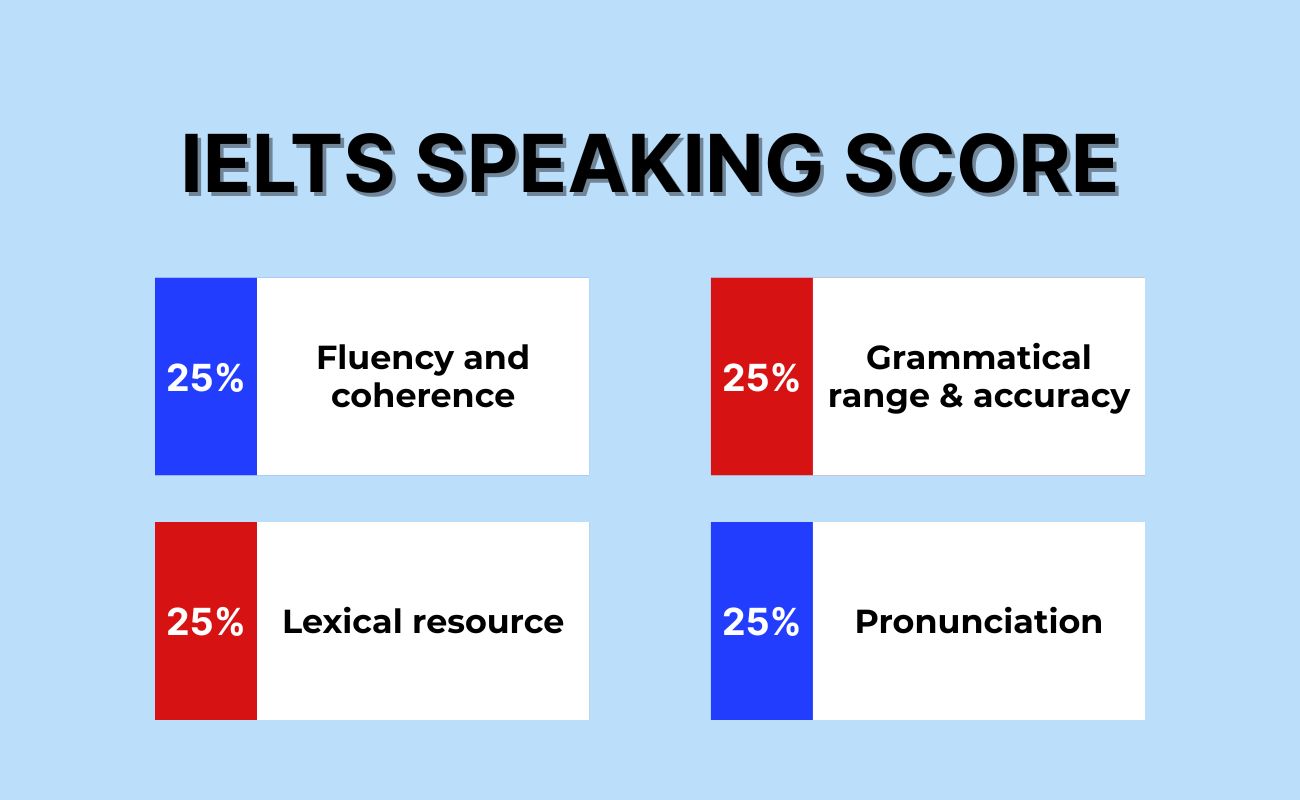
Each is graded from Band 0 to 9, and your final score is the average of all four. This system ensures that one strength can offset another weakness, providing a balanced overall assessment of your speaking ability.
Learn more about the test format and examiner expectations in the IELTS Speaking guide.
2) IELTS Speaking Score Explained (Band Descriptors Table)
As mentioned above, each IELTS Speaking score is determined by four official criteria, carrying equal weight (25%). Below is a summary adapted directly from the official British Council and IDP IELTS Band Descriptors, showing what examiners look for at each level.
| Band | Fluency & Coherence | Lexical Resource | Grammatical Range & Accuracy | Pronunciation |
| 9 | Speaks effortlessly with natural flow and fully developed ideas. | Uses precise, idiomatic vocabulary with full flexibility. | Controls complex structures perfectly; minor slips only. | Uses all pronunciation features precisely; always easy to understand. |
| 8 | Very fluent; rare hesitation and strong topic development. | Wide and flexible vocabulary; idiomatic use mostly accurate. | Produces mostly error-free sentences; good control of complex forms. | Clear rhythm and intonation; accent has little or no effect on clarity. |
| 7 | Generally fluent; occasional hesitation, but meaning always clear. | Good range; can use less common and idiomatic words with some errors. | Frequent error-free sentences; complex structures handled fairly well. | Easy to follow; some influence of accent, but no loss of understanding. |
| 6 | Pauses occasionally to search for words or grammar, but ideas remain connected. | Sufficient vocabulary for most topics; paraphrase usually effective. | Mixes simple and complex forms; errors sometimes affect accuracy. | Generally clear though rhythm and stress control vary. |
| 5 | Speech often slow or repetitive; relies on self-correction. | Limited flexibility; manages familiar topics but struggles with range. | Basic forms mostly correct; complex ones contain frequent errors. | Noticeable mispronunciation, but overall intelligible. |
| 4 | Frequent pauses; coherence often breaks down. | Basic vocabulary; frequent word choice errors; rarely paraphrases. | Mostly short, simple sentences; many errors. | Mispronunciations and weak control of rhythm reduce clarity. |
| 3 | Long pauses; can only produce short or memorized responses. | Very limited vocabulary; struggles beyond personal topics. | Heavy grammatical errors; meaning often unclear. | Hard to understand; many unclear sounds. |
| 2 | Only isolated words or memorized chunks. | Extremely limited vocabulary. | Cannot form basic sentence structures. | Speech largely unintelligible. |
| 1 | Only a few recognisable words. | No usable vocabulary. | No control of grammar. | Completely unintelligible. |
| 0 | Did not attempt the test. | — | — | — |
How to predict IELTS speaking score?
The best predictions come from a mix of structure, practice, and honest reflection.
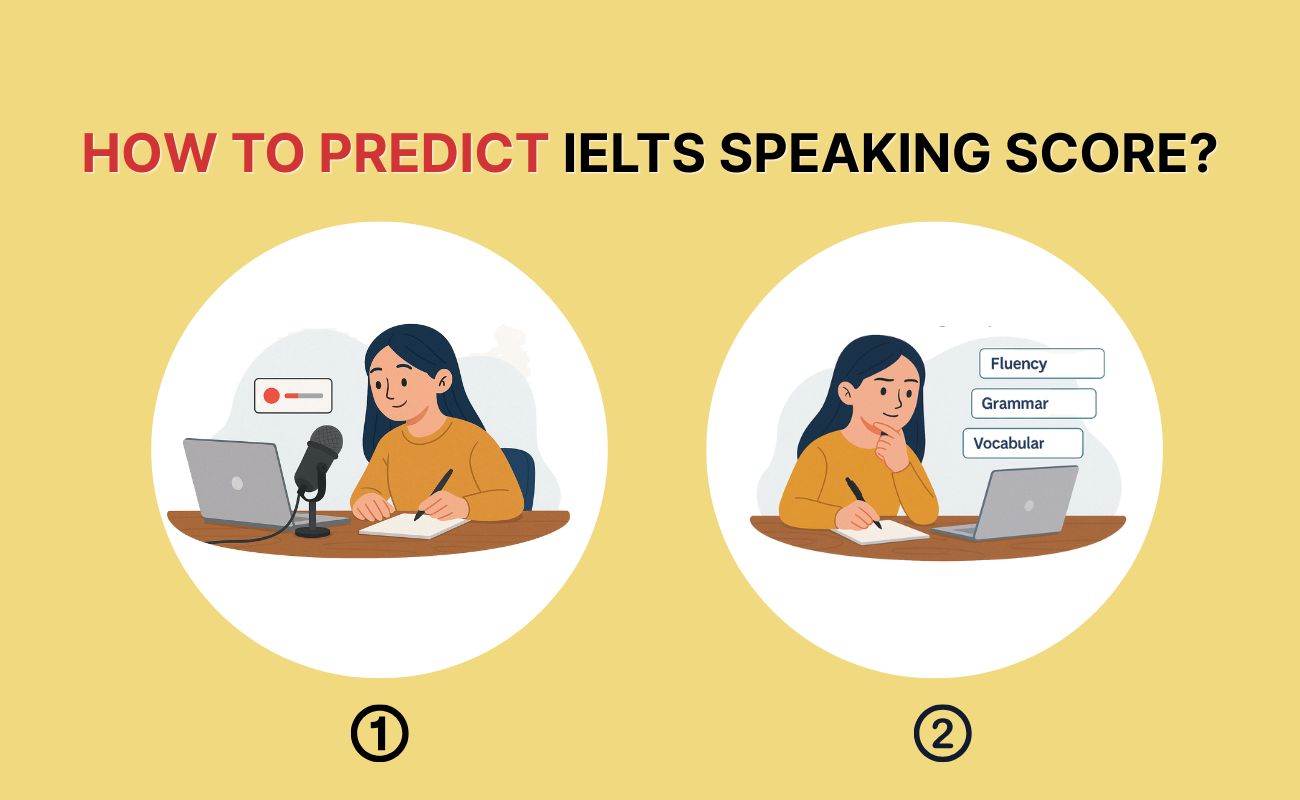
Step 1: Record your full Speaking test
Choose real IELTS topics, answer all three parts, and record yourself in one take. Speak naturally without stopping the timer, just as you would in the exam.
Step 2: Self-evaluate your performance
Replay your recording and assess it based on official criteria or with the help of modern AI tools:
1) Using the Official Band Descriptors
The band descriptors published by the British Council and IDP are the same standards used by real examiners. When reviewing your recording, focus on these four areas:
- Fluency & Coherence: Do you speak smoothly and logically, or pause often to search for words?
- Lexical Resource: Is your vocabulary varied and precise, or repetitive and limited?
- Grammatical Range & Accuracy: Are your sentences mostly correct, and do you use both simple and complex forms?
- Pronunciation: Is your speech clear and natural, with proper stress and intonation?
Give yourself a score (0-9) for each area, then calculate the average. This mirrors how official IELTS examiners determine your final Speaking band.
2) Practicing with Online Tools
If self-rating feels subjective, try an AI-based Speaking evaluation tool for instant and data-driven feedback.
The IELTS Test Pro AI Speaking Tool simulates the real test:
- Select a Speaking topic or full test.
- Record your answers directly in the app.
- Submit for AI-powered scoring aligned with IELTS criteria.
- Review detailed feedback on fluency, vocabulary, grammar, and pronunciation, along with improvement tips.
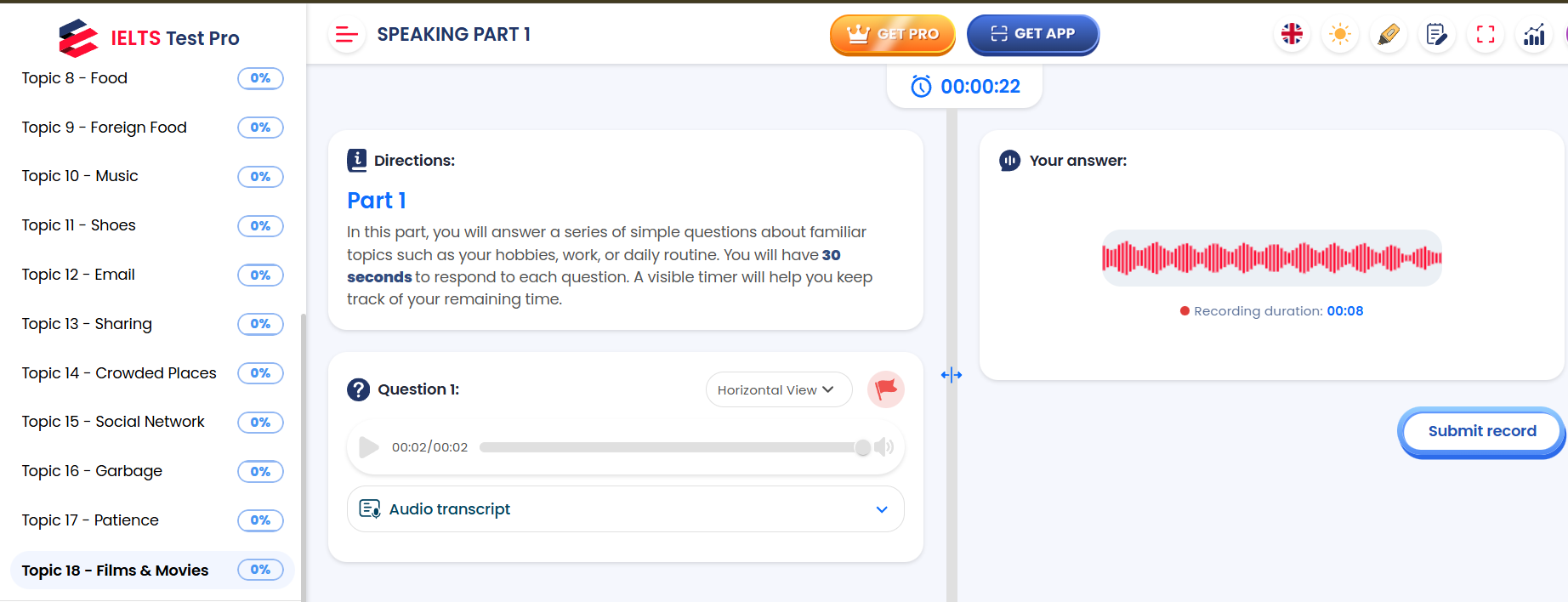
By combining self-assessment, comparison with authentic samples, and AI analysis, you gain a full 360-degree view of your current IELTS Speaking score.
How to Use Your Predicted Score to Improve
Predicting your IELTS Speaking score is just the beginning; what you do next determines your real improvement. After the official test, some candidates receive an email breakdown explaining their performance in each criterion. If you don’t, you can still learn from others’ shared results and use these authentic samples to compare patterns, predict future outcomes, and target your weak areas more precisely.
Here’s how to turn feedback into progress:
- Focus on one criterion at a time: Instead of trying to fix everything at once, choose a single skill and master it step by step.
- Practice with real topics: Use authentic IELTS Speaking questions to train coherence and spontaneity under test-like conditions.
- Record and analyze your speech: Listen for hesitation, filler words, or grammar slips; note where your answers could develop ideas further.
- Use the IELTS Speaking AI tool: Rehearse with the IELTS Speaking tool for instant feedback and band-level insights based on examiner criteria.
- Learn from Band 8-9 samples: Observe how high scorers structure answers, extend ideas, and maintain rhythm, then model these techniques in your own responses.
Conclusion
Your IELTS Speaking score reflects more than test performance; it shows your command of real communication. By understanding how examiners grade and using smart practice tools like the IELTS Test Pro AI Speaking Tool, you can measure progress objectively, refine weaknesses, and practice with purpose.
FAQs
Who marks the IELTS Speaking test?
The IELTS Speaking test is marked by certified IELTS examiners trained under strict global standards by the British Council and IDP. Each examiner follows the same official band descriptors to ensure fair and consistent scoring worldwide.
What is a good IELTS Speaking score?
A Band 7 is generally considered good. It shows you can communicate effectively, use a wide range of vocabulary and grammar, and handle complex ideas with only occasional mistakes.
Do examiners penalize accent?
No. Examiners don’t penalize accent as long as your pronunciation is clear and easy to understand.