
Matching Sentence Endings: Comprehensive Strategies for IELTS Reading
The Matching Sentence Endings task in IELTS Reading challenges candidates to connect incomplete stems with correct endings, rigorously testing grammatical logic and lexical resource alongside comprehension. Often underestimated, this task requires precise skills, and this IELTS-TestPro guide will equip you with the advanced strategies needed to conquer it effectively.
I. Introduction to matching sentence endings in IELTS reading
In this task, you are provided with two lists: the first contains the “stems” (incomplete sentences), and the second contains the “endings” (options A, B, C, etc.). There are always more endings than stems, which serves as a distracter.
To succeed, IELTS-TestPro experts suggest you must master four core skills:
- Skimming: To grasp the general theme of the paragraphs.
- Scanning: To rapidly locate specific keywords from the stems in the text.
- Paraphrasing Identification: To recognize that the text will rarely use the exact words found in the questions.
- Syntactic Prediction: To use grammar rules to predict the type of word or phrase that fits the stem.
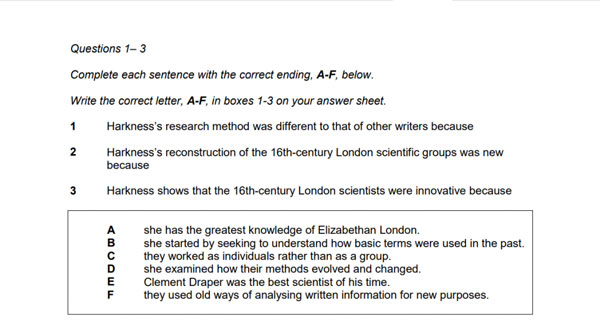
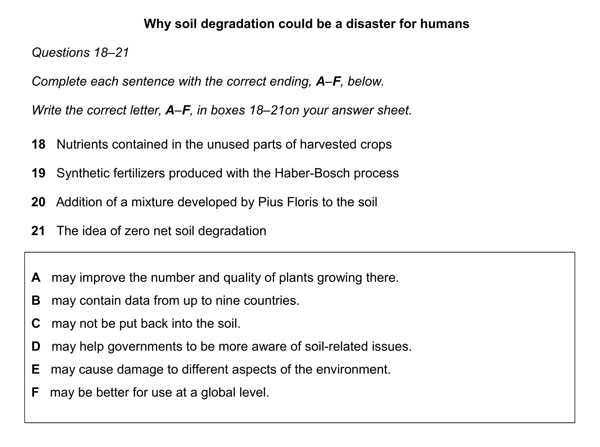
>>> Practice now: IELTS Reading Practice Test
II. Matching sentence endings strategies
Don’t just read and hope for the best. Follow this systematic, step-by-step strategy refined by our team at IELTS-TestPro.

1. Step 1: Read the Incomplete Sentences First
Do not start with the text. Instead, focus entirely on the incomplete sentences (the questions). Reading these first gives you a “roadmap” of what information you need to find. This saves valuable time compared to reading the passage aimlessly.
2. Step 2: Identify and Highlight Keywords
In the “stems,” circle or underline the most “searchable” words.
- Prioritize: Proper nouns (names), dates, numbers, and capitalized words. These are difficult to paraphrase and easiest to scan.
- Anticipate Synonyms: As you highlight, brainstorm how these words might appear in the text.
- Example: If the stem says “marine creatures,” expect the text to mention “sea animals” or “fish.”
3. Predict the appropriate endings for each incomplete sentence
You can make predictions for each sentence immediately by means of noticing word type or part of speech (verbs, nouns, adjectives or adverbs), and/or grammatical rules.
| e.g.
1 The ancient species of crocodile ate marine creatures that + verb (past simple tense) 2 The skeleton is kept in + noun (a place) 3 Bones of the early type of crocodile + verb 4 The geology of southern Germany + verb |
4. Read the sentence endings to get the general meaning
Don’t forget to look over the endings, but not in detail, to get the general meaning. Highlight keywords and note the obvious answer if any.
| A is believed to be 150 million years ago.
B show some unique features. C resembled dolphins. D was laid down when the area was under water. E a museum in the town near where it was found. F swam fast through the water. G the University of Edinburgh’s School of GeoSciences. |
5. Think about possible matches and Eliminate the unsuitable choices
Depending on the grammatical structures, collocations, or meaning, candidates can look for the possible combinations in the list of endings for each incomplete question. Matching Sentence Endings may have more than one option for one question, so you should write down all these possibilities next to the sentence you are considering.
| e.g.
1 The ancient species of crocodile ate marine creatures that C, F 2 The skeleton is kept in E, G 3 Bones of the early type of crocodile B 4 The geology of southern Germany A, D |
Moreover, some unbefitting endings (ungrammatical structure, incorrect verb tense, etc) can be removed right away. This can narrow down your searching later and save your time indeed.
>>> Read more: IELTS Reading Short Answer Questions
6. Step 6: Locate the Information in the Text
Use your highlighted keywords from Step 2 to scan the text.
The “Order” Rule: Remember, in Matching Sentence Endings, the information in the text usually appears in the same order as the questions. If you find the answer to Question 1 and Question 3, the answer to Question 2 is likely between them.
7. Step 7: Verify and Select
Once you locate the relevant sentence in the text, read it carefully (intensive reading). Compare the meaning with your shortlisted endings.
Trap Alert: Do not just match words. Match the meaning. Ensure the completed sentence accurately reflects the text’s information.
8. Step 8: Final Grammar Check
Read the complete sentence (Stem + Selected Ending). Does it make grammatical sense? If the subject is singular but the verb is plural, it is incorrect, regardless of the vocabulary.
III. Common mistakes and tips for matching sentence endings in IELTS reading
Even advanced learners fall into specific traps. Here is how to avoid them, drawn from IELTS-TestPro’s analysis of common candidate errors.

| Common Mistakes | Tips |
| 1. Reading carefully the whole text before questions
Some test-takers try to read and understand the whole reading passage immediately, then they have to struggle a lot with the time limit. |
Firstly, read the incomplete questions and the lists of possible endings, then move to locate the respective paragraphs. |
| 2. Leaving blank answers
Don’t give a blank answer as you may lose a chance to get a point from your prediction |
If you hesitate to give the final answer to a question, write it down onto the answer sheet and you may get a point |
| 3. Looking for the exact same words or phrases in the reading text after reading the short answer questions
The IELTS Reading test want to check your wide range of vocabulary and ability to guess the meaning of certain words or phrases, so there is no point trying to find exact similar words or phrases in the text |
Think of synonyms and paraphrases of keywords and look for those in the passage |
| 4. Apply background knowledge or logic to answer the questions
Test takers can sometimes find an issue or a article familiar with them, which leads them to choose the answers based on their background knowledge or personal experience instead of information in the reading passage. This, however, will be a mistake that can loose your point. |
Use the actual words in the reading passage only |
| 5. Being trapped by the examiner
You may be tricked by the examiners when there exist some endings that sound suitable for the incomplete sentence, but it is actually not the answer for the question. |
Note your predictions next to the sentence you are considering before reading the text, and read in detail and carefully after locating the part containing the information of that sentence. |
Other tips for Matching Sentence Endings in IELTS Reading:
- The answer to the next question will be below the previous one so don’t worry too much about the order of questions
- Use your time wisely with the easier ones first and leave the hesitated questions behind for later recheck
- Don’t try to use all the endings in the list as the number of those are always more than the number of incomplete sentences.
- The grammatical structure, collocations, or meaning can help you with checking your answer, so take the most advantage of this.
- The first question is often designed as the most difficult one with the most possibilities, so you should spend more time on this. In contrast, the last question seems to be less time-consuming because you have fewer options left to choose.
IELTS Reading Matching Sentence Endings can become one of the advantageous question types for you in an IELTS Reading test if you practice and apply these strategies as well as tips above mentioned.
Apply our app – IELTS Test Pro and practice with Matching Sentence Endings now!