
Master IELTS Listening Summary Completion: Strategies & Tips
In the IELTS Listening test, Summary Completion challenges your ability to listen, read, and write simultaneously. You must fill in gaps within a paragraph that summarizes the recording, often relying on synonyms rather than exact word matches. At IELTS-Testpro, we recognize this as a test of your paraphrasing skills. This guide cuts through the noise to equip you with the essential strategies needed to navigate linguistic traps and secure a high score.
I. Introduction to IELTS Listening Summary Completion Questions
A summary which means a short description consists of opinions and/or key information about a specific topic. Therefore, to face up to IELTS Listening Summary Completion Questions, you should make the most of two essential skills including summarising and paraphrasing skills.
You, of course, will be listening to the recording and at the same time, will be filling in the gaps for those questions that sum up a segment of the audio. Nonetheless, the speaker will use different words from the Summary Completion Questions but with the same meaning. In other words, you need to read questions to get the best understanding, then listen to the recording with synonyms & paraphrases describing the summary and try to figure out details to complete the blanks.


You need to bear in mind that preparing a good strategy, practicing day by day, and taking some tips into account will help you pass IELTS Listening Summary Completion Questions.
II. IELTS Listening Summary Completion Questions Strategies
Success lies in preparation. Use the silence before the audio starts to apply this IELTS-Testpro workflow.
1. Analyze the Instructions (The Golden Rule)
Never rush past the instructions. The word limit is strictly enforced and often changes between sections. Failing to adhere to this is the most common reason for losing easy marks.
- Example: “NO MORE THAN TWO WORDS AND/OR A NUMBER”.
- Rule: Pay close attention to the “AND/OR” part. If the answer is “150 dollars” (one number, one word), it is valid. However, if the limit is “ONE WORD” and you write “a doctor”, you get zero points. You must write “doctor”.
2.Identify Keywords & Topic
Quickly read the title to grasp the context. Then, scan the summary and underline key nouns, dates, or names. These act as “anchors” to help you keep your place in the audio.
IELTS-Testpro Tip: Always anticipate synonyms. If you underline “favorite game” in the text, do not wait to hear those exact words. Expect to hear “most popular sport” or “widely loved activity” in the recording. Being mentally prepared for this switch is crucial.
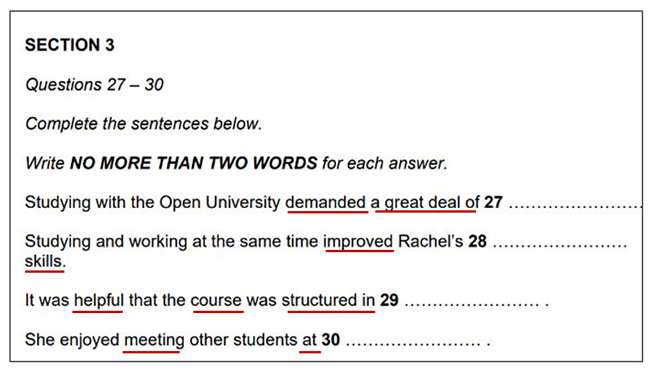
3. Predict the Answers (The “Ghost” Technique)
Use the 30-second preparation time to guess what is missing. Is it a Noun? A Verb? A Number? This “brain priming” helps you filter out irrelevant information when the audio starts.
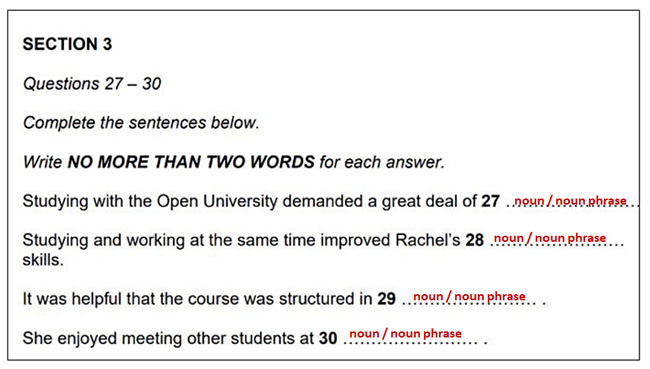
Example predictions based on context:
- Q27: Criteria for learning -> Predict a noun like motivation, determination, or focus.
- Q28: Skill for working -> Predict a skill noun like time management or teamwork.
- Q29: Format of the course -> Predict an adjective/noun like online, part-time, or modular.
- Q30: A place -> Predict a location like library, campus, or laboratory.
4. Listen and fill in the blanks
As the audio plays, keep your eyes on the keywords you underlined. Write the answer down immediately when you hear it—don’t trust your memory.
- Stay Moving: If you miss an answer, do not dwell on it. Look immediately at the keywords for the next question. If you panic over one missed blank, you risk losing the audio stream for the subsequent questions.
5. Double-check answers
In the final 10 minutes (paper-based) or 2 minutes (computer-based), check spelling and grammar. Context is key here.
- Grammar Check: Does the sentence make sense? If the sentence is “He is a ______”, the answer must be a singular noun (e.g., teacher). If you write teachers, it is grammatically wrong and will be marked incorrect.
- Spelling: Common words like environment, government, and separate are frequently misspelled.
>>> Read more: Strategies and tips for IELTS listening short answer questions
III. Tips for IELTS Listening Summary Completion
To push your score to the next level, keep these expert insights from IELTS-Testpro in mind:

1. Watch Out for Distractors (The “But” Trap)
Examiners love to trick you with contrast words like but, however, sorry, except. They will often give you a piece of information that sounds like the answer, only to correct it immediately after.
- Scenario: “The estimated cost was $7 million… however, the final bill came to $102 million.”
- Action: Don’t write the first number you hear. Wait for the speaker to confirm the final fact. Always listen for the correction.
2. Follow the “Signposts”
Speakers often use signposting language to indicate they are moving to the next point in the summary. These are verbal cues that structure the talk.
- Cues to listen for: “Let’s move on to…”, “Turning now to…”, “On the other hand…”, or “Firstly/Secondly…”.
- Action: When you hear these, move your eyes to the next section of the summary immediately.
3. Never Leave Blanks
There is no penalty for wrong answers in IELTS. If you miss a question completely, make an educated guess based on grammar and context.
Why: A blank answer is a guaranteed zero. A guess (e.g., predicting a noun that fits the context) gives you a statistical chance of being right.
4. Master Multitasking
You must read the summary, listen to the audio, and write the answer simultaneously. This cognitive load can be heavy.
IELTS-Testpro Advice: Practice “shorthand” writing. If the answer is “environment”, write “env” and fix the spelling later during the transfer time. This keeps your mind free to listen for the next point.
Theory is essential, but practice builds reflex. Download the IELTS Test Pro app today to practice hundreds of Summary Completion questions with real audio and instant feedback!