
Mastering IELTS Listening Multiple Choice Questions with IELTS-Testpro
IELTS Listening Multiple Choice Questions are notoriously tricky, requiring deep interpretation rather than just keyword spotting. In this guide, IELTS-Testpro breaks down common traps and provides a proven strategy to help you master this difficult task type and boost your band score.
I. Introduction to IELTS Listening Multiple Choice Questions
Multiple Choice Questions (MCQs) typically appear in Part 2 and Part 3 of the listening test—and occasionally in Parts 1 and 4. These questions require a high level of concentration and analytical skill because you must process a large amount of information in a short time.
Unlike straightforward gap-filling tasks, MCQs present you with a question stem and three or four options, only one of which is correct. The challenge lies not just in hearing the words, but in understanding detailed arguments, distinguishing between similar options, and identifying paraphrased information.
At IELTS-Testpro, we classify these questions into four primary formats to help you identify them instantly:
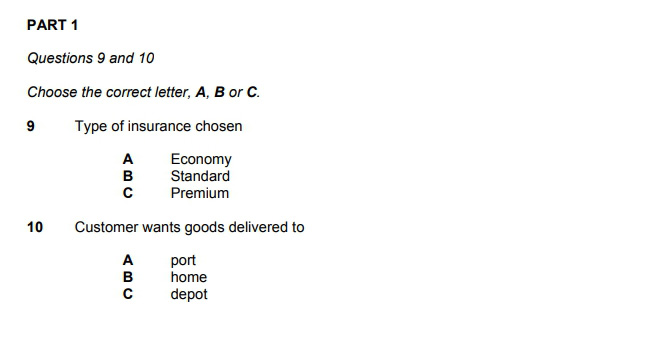
- Short Answer Multiple Choice Questions: A direct question followed by three distinct, brief options.
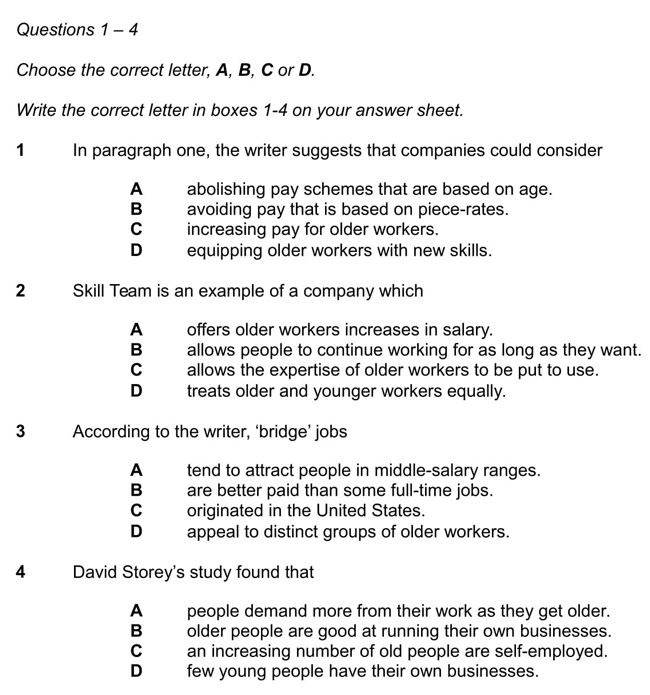
- Sentence completion Multiple Choice Questions: An incomplete sentence stem where you must choose the option that grammatically and logically completes the thought.
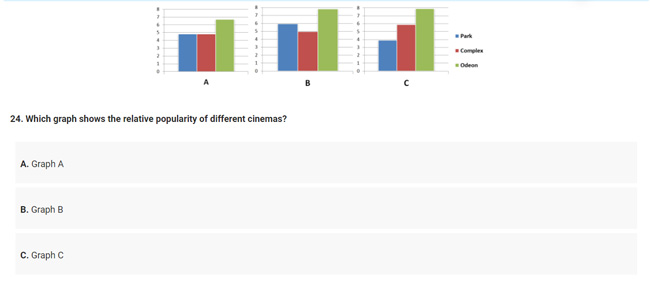
- Matching pictures Multiple Choice Questions: You are presented with visual options (maps, diagrams, or objects) and must select the correct image based on the description.
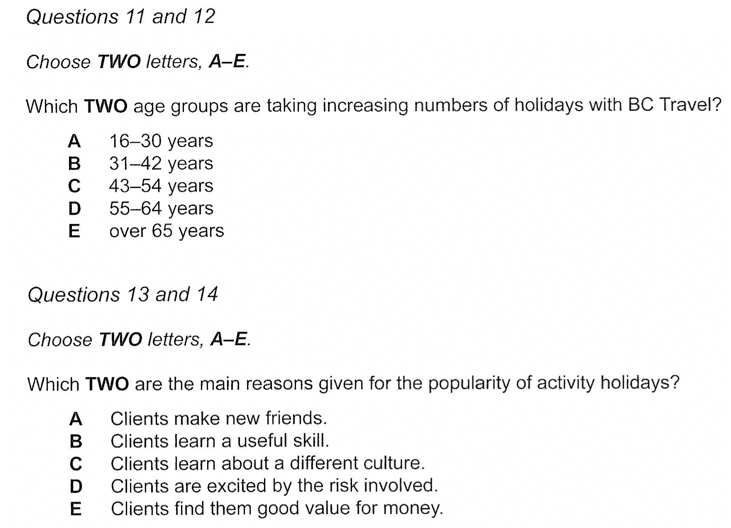
- More-than-one-answer Multiple Choice Questions: A question offering a longer list of options (usually 5–7), requiring you to select more than one correct answer (e.g., “Choose TWO letters”).
Whilst listening to the audio, you have to analyse the questions and comprehend what the speaker is talking about at the same time in order to choose the correct information from the recording.
Although the difficulty of multiple choice questions in the IELTS Listening test is undisputed, you can conquer it successfully with a suitable strategy. That’s what this article can help you with.
II. IELTS Listening Multiple Choice Questions Strategies
To conquer the undisputed difficulty of MCQs, you need a systematic approach. Here is the IELTS-Testpro 5-step strategy to maximize your accuracy.
1. Read the instructions carefully
Take a look at the instructions to identify what type of Multiple Choice Questions you are confronting. Remember to highlight or underline the requirements so that you won’t definitely miss it.
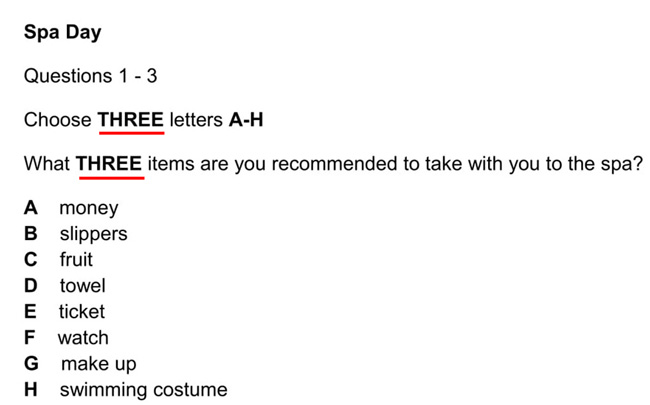
2. Read and identify key words in the questions
Reading to understand thoroughly each question and their corresponding choices should be prioritized because it can provide a context which you can base on to follow the recording and give the correct answer. Besides, underlining or highlighting key words in multiple choice questions as well as options is a good way to locate information while listening. Try to look for the differences among options.
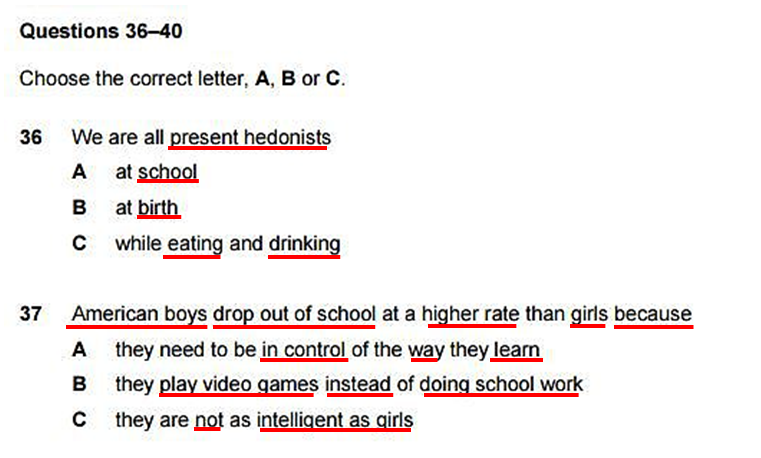
Nevertheless, you should get used to synonyms or paraphrases and do not expect the exact same words in the audio. As a result, thinking of the possible synonyms or paraphrases for changeable words in advance can save your time and boost the chance to mark a point.
You can prepare for your IELTS test by using our free IELTS online tests on this website.
3. Predict the answers
This is a critical “Deep Listening” skill. Do not expect to hear the exact words from the options in the audio.
- Paraphrasing: The speaker will likely use synonyms, antonyms, or totally different sentence structures to express the same idea.
- Elimination: Use logic to predict answers. If an option seems logically impossible based on the context or grammar, mark it as unlikely.
- Example: If the question asks about a price, and Option C is “Free,” but the context implies a luxury service, Option C is likely a distractor.
4. Listen and choose the correct answers
When the audio plays, listen for the meaning, not just matching words.
- The Trap: IELTS speakers often mention keywords from all the options to confuse you. They might say something and then immediately correct themselves.
- The Pivot: Listen for “contrast markers” or “signposting language” (e.g., however, but, actually, on second thought). These words often signal that the previous information was incorrect and the real answer is coming.
5. Double-check answers
Take advantage of the last 10 minutes of the Listening test to recheck the answers while transferring them to the answer sheet. Don’t forget that your answer will be a letter, not a word.
>>> Read more: IELTS Listening Matching Questions
III. Tips for IELTS Listening Multiple Choice Questions
To further refine your performance, IELTS-Testpro recommends keeping these advanced tips in mind. These address the most common grammatical and logical errors students make.

- Read the instructions in the first place. Be careful with the number of options you can choose, and remember that your answers will be normally a letter, not a word.
- Take advantage of synonyms and paraphrases for changeable keywords and you may catch the information of the questions more effortlessly
- Listen in detail to the information and notice the contrast words such as however, but, except, apart from, etc. (e.g. The coach will be returning to the hotel at 5.30 p.m. No, sorry, we’ve changed it to 6 o’clock to avoid the worst of the rush hour traffic.) because the speaker may alter his or her opinion
- Keep listening after locating the information since the speaker may change the answer or add more details then
- Focus on the meaning of the audio instead of instantly looking for the keywords and trying to match them with the questions
- Don’t choose the first word you can hear immediately because normally words from all options will be mentioned in the recording. Therefore, you need to listen carefully to all the options and decide what is the final answer
- Practice more with your reading skill as there is much more information to read in terms of multiple choice questions and the more quickly you can read and understand different options, the more chance for you to get a point.
- Take your time to prepare for the next part of the Listening test in place of checking answers right away. It is more fundamental to understand the questions and options in detail.
IV. Practice Exercise: Multiple Choice
Apply the strategies above to the following mini-test.
Context: You will hear two students discussing their university project.
Question 1: What is the main problem with the students’ current project? A. It is too long. B. The topic is too broad. C. They have missed the deadline.
Question 2: What does the professor suggest they focus on? A. The economic history of the region. B. The impact of tourism on local wildlife. C. The changes in local architecture.
Question 3: How will they gather their data? A. By conducting online surveys. B. By interviewing local residents. C. By reading old newspapers in the library.
V. Answer Key & Explanation
1. Answer: B (The topic is too broad)
- Explanation: The speakers might mention the deadline (distractor C) but say they still have time. They might discuss length (distractor A), but conclude it’s okay. The core issue will be described as “trying to cover too much” or “lacking focus,” which paraphrases “too broad.”
2. Answer: C (The changes in local architecture)
- Explanation: Listen for the professor’s specific advice. Options A and B might be mentioned as things they shouldn’t do or things they used to consider.
3. Answer: B (By interviewing local residents)
- Explanation: Watch out for distractors. They might say, “We thought about online surveys (A), but nobody responds to them,” or “Library archives (C) are closed for renovation.” The final decision involves talking to people directly.
Ready to master this skill? Download IELTS TEST PRO now to access hundreds of practice questions and detailed explanations just like this!